Why coating conditions matter as much as the product itself
Most conversations about ceramic coatings focus on the product: how many layers, what brand, what hardness rating. Those things matter, but they are secondary to a variable that rarely gets discussed with owners — the environment in which the coating is applied. Get the product wrong and you might lose some durability. Get the environment wrong and the coating may fail inside its first season regardless of what is in the bottle.
This is not a theoretical concern. Houston and the surrounding North Texas corridor sit in one of the most challenging installation climates in the country. High ambient humidity, temperature swings between seasons, and pollen loads that rival any market in the country make environmental control a genuine technical requirement, not a selling point. Understanding what goes wrong — and why it goes wrong — helps you evaluate installers more accurately than any five-star review.
What happens to a coating when humidity is too high
Ceramic coatings cure through a condensation reaction. The SiO2 or SiO2/TiO2 chemistry in professional-grade products like Gyeon crosslinks as it contacts trace moisture in the air. That sounds counterintuitive — moisture helps the cure — but the relationship is not linear. A small amount of ambient humidity is acceptable, even useful. Relative humidity above roughly 70 percent introduces too much moisture too quickly, which drives flash curing on the surface before the coating has time to level and bond uniformly to the clear coat.
The visible result is high spots: slightly hazy or rainbow-edged patches that form within minutes of application. Installers sometimes catch these during the initial wipe stage, but high humidity can cause them to appear faster than the working window allows for correction. In severe cases the installer is chasing spots across the panel rather than applying and leveling in a controlled sequence. The coating that ends up on the car may look fine under artificial lighting in the bay, but it will show inconsistent hydrophobic behavior and uneven gloss within the first few washes.
In Tomball and the broader North Houston area, outdoor humidity regularly sits between 75 and 90 percent for most of the year. Any shop applying coatings in an open or inadequately conditioned space is working against the chemistry from the first panel.
Temperature and its role in working time
Coatings are rated for an application temperature window, typically somewhere between 50°F and 90°F at the surface. Below the lower threshold, cross-linking slows dramatically. The coating stays workable longer, which sounds convenient, but slow curing also means the film remains vulnerable to contamination — dust, pollen, fingerprints — for an extended period. Worse, if surface temperature is below the dew point, you risk moisture condensing onto the clear coat between the decontamination stage and the coating application itself, which compromises adhesion at the substrate level.
High surface temperatures present the opposite problem. In a Texas summer, an exterior panel parked in direct sun can reach 140°F or higher. Applying any professional coating to a panel at that temperature means the solvent flashes out almost instantly, leaving a film that has not had time to wet out properly across the clear coat’s micro-texture. The coating sits on top rather than bonding into the pores, and the durability is compromised from day one even if the gloss looks acceptable on pickup day.
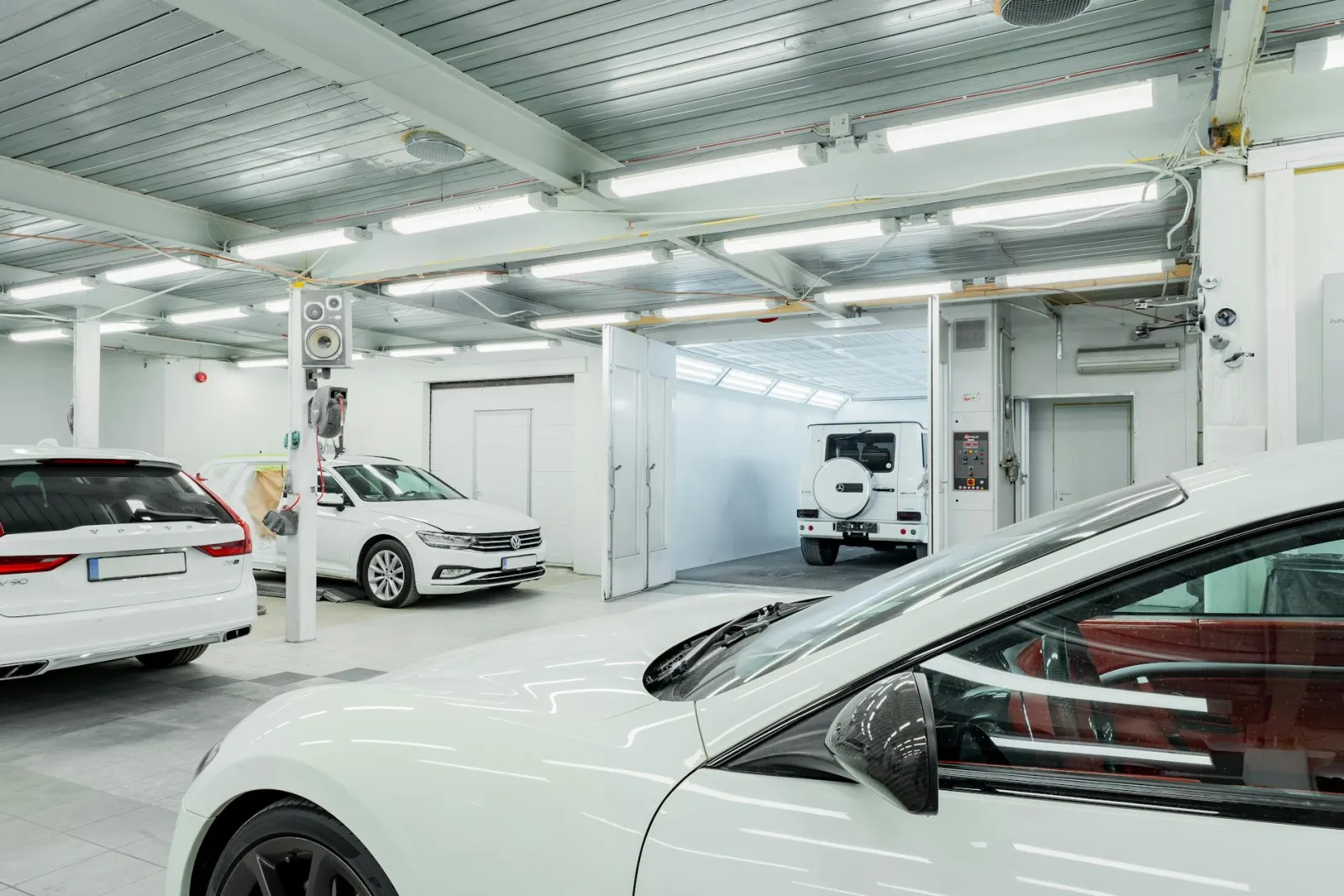
This is one reason ceramic coating work at EuroLuxe is performed inside a climate-controlled installation bay. Controlling surface temperature is only possible indoors, and the bay environment has to be maintained consistently from the wash and decontamination stages through final cure — not just during the application itself.
Surface prep under controlled conditions
Environmental control does not begin when the coating goes on. It begins the moment the vehicle enters the bay for prep. Paint decontamination, clay bar treatment, and any paint correction work all generate heat and leave the surface in a sensitized state. If the bay is too warm, solvent residues from polishing compounds flash before they can be fully removed with a final IPA wipe. If humidity is elevated, the clear coat can pick up trace moisture during the transition from correction to coating application.
Professional installers sequence their work specifically to manage this. Correction is completed, residues are removed, the surface is given time to equalize in temperature, and an IPA or dedicated panel wipe is applied to remove any remaining oils or polish residue immediately before coating. If you do that sequence in a humid, uncontrolled environment, the panel wipe step may itself introduce a contamination problem as evaporation slows and the panel sits longer than it should before the coating goes on.
The entire prep-to-application pipeline needs to happen in a controlled environment from start to finish. Breaking that chain at any point — even briefly pulling the car outside between stages — introduces variables that compound.
How pollen and airborne contamination factor in
North Houston has a pollen season that runs roughly from late winter through late spring, with oak, cedar, and pine all contributing at different peaks. Pollen particles are large enough to embed in a wet coating film before it has cured past the tacky stage. An installer working in an open bay or in a facility without positive air pressure filtration is working in an environment where contamination is continuous, not occasional.
A single pollen particle embedded in a ceramic coating during cure does not just create a defect at that point — it creates a raised inclusion that collects dirt and makes the surrounding area harder to clean uniformly. On a black or dark vehicle the effect is more visible, but it occurs on every color. Climate-controlled bays with filtered, positive-pressure air substantially reduce this problem. They do not eliminate it entirely, which is why professional installers also work in sections and keep the vehicle covered during any staging intervals between panels.
What to ask before you commit to a shop
The environment question is one of the most useful filters when evaluating shops for coating work. A facility that can describe its bay temperature range, its humidity management strategy, and how it sequences prep relative to application conditions has clearly thought through the chemistry. A facility that cannot answer those questions — or gives a vague response about doing the work on nice days — is likely applying a professional-grade product in consumer-grade conditions.
The coating brand matters. Gyeon’s professional lineup uses a specific chemistry that performs well under controlled application, but it is not forgiving of shortcuts in the environment. That is a feature, not a drawback — it means the performance spec you are paying for is achievable, but only if the install is done correctly. Consumer-grade or spray-on coatings often have wider application windows because the film thickness and chemistry are engineered for forgiveness rather than peak performance. You trade the application flexibility for a significant reduction in hardness, bonding depth, and longevity.
If you are researching a ceramic coating for a vehicle in the Tomball, Woodlands, Cypress, or Conroe area, the installation environment should be one of the first questions you ask, not an afterthought. Call (936) 292-6056 to discuss how EuroLuxe approaches the prep and application sequence, or to schedule an in-person look at the bay before you commit.
A coating that is applied correctly in a controlled environment will behave exactly the way the product is designed to behave. One that is applied in the wrong conditions will underperform that spec from day one, and no amount of maintenance will recover what was lost during the cure window. The product matters, but the environment in which it is installed matters just as much.