Ceramic coating at two years: what to inspect and why it matters
Most ceramic coating conversations happen at the beginning — before the car goes in, while the owner is comparing products and pricing. Very few happen at the two-year mark, which is exactly when they should. A professionally applied coating does not fail overnight. It degrades gradually, and by the time an owner notices water sheeting less aggressively or contamination sticking where it used to bead off, the coating has usually been declining for months. A structured inspection at the two-year point gives you an honest picture of where the coating stands and what, if anything, needs to happen next.
This is not a panic exercise. A Gyeon coating applied correctly, maintained with proper wash chemistry, and protected from harsh automated car washes will often be performing well at two years. But the inspection is how you know that for certain, rather than assuming it. The findings also set up the decision between a maintenance treatment, a top coat booster, or a full reapplication — and making that call on real data rather than a sales pitch is what separates good long-term paint stewardship from guesswork.
What actually changes in a ceramic coating over two years
Ceramic coatings are SiO2-based films that bond to the clear coat. Over time, the outermost layer of the coating experiences abrasion from wash contact, UV exposure, environmental fallout, and the physical impact of rain and road debris. The coating does not disappear at once. It thins from the top down, and the areas that thin fastest are almost always the horizontal surfaces — hood, roof, trunk lid — because those panels take the most direct UV load and accumulate contamination more readily than vertical panels.
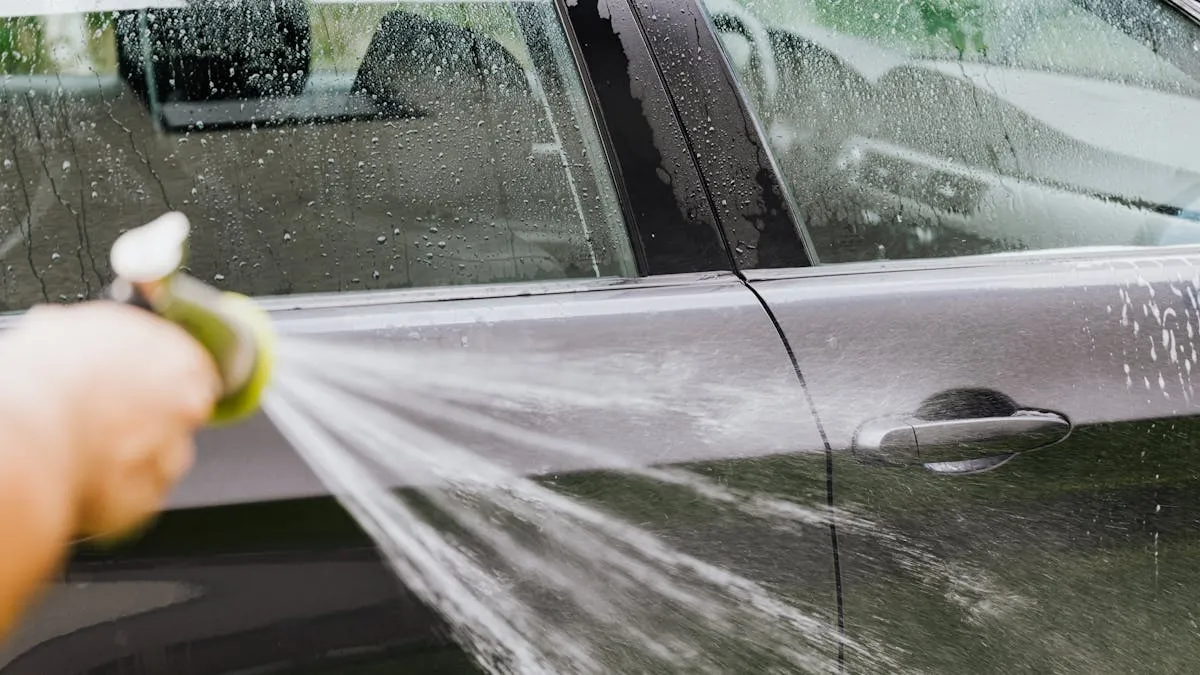
The hydrophobic behavior of the coating is one of the clearest early indicators of wear. When the water contact angle drops — meaning water spreads rather than beading or sheeting cleanly — the top layer of the coating has lost significant surface energy. The coating may still be present and providing some chemical resistance, but the self-cleaning behavior that makes it practically useful has diminished. You can observe this with a simple rinse on a freshly washed car. On a healthy coating, water sheets off horizontal surfaces in large, thin films. On a tired coating, it sits in smaller beads or puddles.
The areas that wear earliest and why
Horizontal surfaces lead the wear conversation, but within horizontal surfaces, there are specific zones that degrade faster than surrounding paint. The front third of the hood accumulates road grime, bug acids, and airborne particulates at a higher rate than the rear portion. On vehicles that park outdoors under trees, any area regularly exposed to sap drip or bird traffic will show localized depletion even if the rest of the coating is in solid shape.
Rocker panels and lower doors are a different failure mode. These areas take physical abrasion from kicked-up road debris and often accumulate iron fallout from brake dust. If the vehicle does not receive regular iron decontamination during maintenance washes, iron particles embed in the coating and begin to oxidize. This does not always mean the coating is gone, but it does mean it is compromised in that zone and the contamination needs to be addressed before any corrective treatment is applied.
Side mirrors are frequently overlooked. They sit in the airstream and collect a concentrated stream of water, debris, and contamination. On many vehicles the mirror caps will be among the first surfaces to show visible water spotting from mineral deposits, even when the door panels immediately adjacent still look clean.
How a professional two-year inspection is structured
A thorough inspection is not a visual sweep in sunlight. It starts with a decontamination wash to remove any surface contamination that could mask the condition of the coating underneath. Once the paint is clean and dry, a technician works the car under a focused light — typically a rotary light or a panel light placed at a low angle — to evaluate gloss depth, surface clarity, and any visible marring that has accumulated.
Water behavior is tested panel by panel. The technician notes which surfaces still sheet cleanly, which have reduced beading, and which show no meaningful hydrophobic response. An infrared coating thickness gauge can give additional data, but coating thickness inspection is more useful for verifying the substrate than for measuring the coating layer itself, which is thinner than most gauges can reliably resolve.
The inspection also covers adhesion failure signs. At two years, a coating applied over improperly decontaminated paint may show early delamination at panel edges or around badges. This shows up as a subtle haze or as areas where the coating has pulled away from the surface and trapped contamination underneath. These zones require careful attention before any remediation work proceeds.
What the inspection results mean for next steps
The outcome of the inspection generally falls into three categories. The first is a coating that is wearing evenly and still performing well across all major surfaces. In this case, an annual SiO2 booster application extends the life of the existing coating without requiring a full strip and reapplication. A spray-on or wipe-on ceramic maintenance product bonds to the existing coating layer and refreshes the surface energy that has been depleted. This is the lowest-cost and lowest-disruption outcome.
The second scenario is uneven wear — horizontal surfaces have thinned significantly while vertical panels remain in good shape. Here, a targeted booster or single-stage enhancement on the degraded panels can restore uniform performance without a full reapplication. If paint correction is needed to address marring that has accumulated in the thin zones, that work needs to happen before any new coating or booster is applied, because covering contamination and scratches with fresh product does not resolve the underlying surface condition.
The third scenario is a coating that has reached the end of its practical life across most surfaces, with contamination embedded too deeply for a booster to address, and surface defects that have accumulated to the point where the owner wants the car returned to a clean baseline. This is a full decontamination, correction, and ceramic coating reapplication — the same process as the original service. Two years is generally early for this conclusion on a well-maintained vehicle, but on cars that spent those two years going through tunnel washes or sitting under heavy tree cover without regular decontamination, it is sometimes the realistic answer.
How maintenance habits between inspections change the outcome
The condition of a coating at two years is largely determined by how the vehicle was washed in the months between. Automated car washes with rotating brushes are the single most damaging regular exposure a coated car can experience. The mechanical abrasion from those brushes cuts through the top layer of the coating and introduces the swirl marks and fine scratches that reduce gloss depth and surface clarity. A car that has been washed exclusively by hand or with a touchless rinse setup will almost always show meaningfully better coating condition at the two-year point than a car that went through a tunnel wash even occasionally.
Wash chemistry matters as well. Harsh detergents and degreasing agents strip the coating’s surface energy faster than pH-neutral shampoos formulated for coated vehicles. Owners who used whatever soap was available rather than a dedicated coating-safe product often arrive at two years with a coating that looks older than it should.
The other major variable is how quickly contamination was addressed after exposure. Bird droppings, tree sap, and insect acids left on the surface for extended periods etch through the coating and into the clear coat. On a properly maintained coating, most of these events are recoverable without damage. Left for days in Texas summer heat, they can cause permanent marks that require correction, not just a fresh booster coat.
Making the decision without guesswork
Owners who come in for a two-year check are in a much better position to make a sound decision than owners who wait until the coating is visibly failing. The inspection takes out the guesswork and replaces it with direct observation of actual surface conditions. It also gives the technician enough information to give a realistic cost estimate for whatever remediation makes sense — without having to pad the quote for unknowns.
If you have a coated vehicle approaching or past the two-year point in the North Houston area, call EuroLuxe at (936) 292-6056 to schedule an inspection. The appointment gives you a clear picture of where your coating stands and what it will take to keep it working for the next phase of the vehicle’s life.
A ceramic coating is not a one-time transaction. It is a maintenance system, and the two-year inspection is the most important checkpoint in that system. Owners who treat it as such tend to preserve both their paint and the value of the original coating investment far longer than those who set it and forget it.