How to Dry Your Car Without Scratching the Paint
Drying your car sounds like the easy part. You washed it, now you wipe it down. But this is where most paint damage actually happens. The wrong towel, the wrong technique, or the wrong order of operations will leave swirl marks across the paint every time — the same swirls you’d pay hundreds of dollars to have corrected later.
Here’s what causes the damage and how to avoid it.
Why Regular Towels Are a Problem
A standard bath towel or cotton terry cloth feels soft to the touch, but it has a relatively coarse fiber structure. When you drag it across paint with any pressure at all, those fibers catch microscopic particles of dust, dirt, or road grime that weren’t fully rinsed off, and drag them across the clear coat. The result is fine scratches that scatter light and create the dull, swirly appearance that’s visible in direct sunlight.
The same applies to old microfiber towels that have been washed with fabric softener, dried on high heat, or are past their useful life. A microfiber towel that’s matted or stiff is no better than a cotton rag.
The physics don’t change based on how clean the towel looks. Any abrasion at the paint surface — even from something soft — will scratch a clear coat over time.
The Right Tools for Drying
Microfiber Drying Towels
A quality microfiber waffle-weave or plush drying towel is the baseline for safe drying. You’re looking for:
- GSM (grams per square meter) of 600 or higher for plush towels — thicker pile holds more water and makes less contact pressure with the paint
- Waffle weave pattern for maximum water absorption — the grid structure pulls water off the surface quickly with minimal wiping passes
- No tags or sewn edges against paint — always fold so the edges face inward
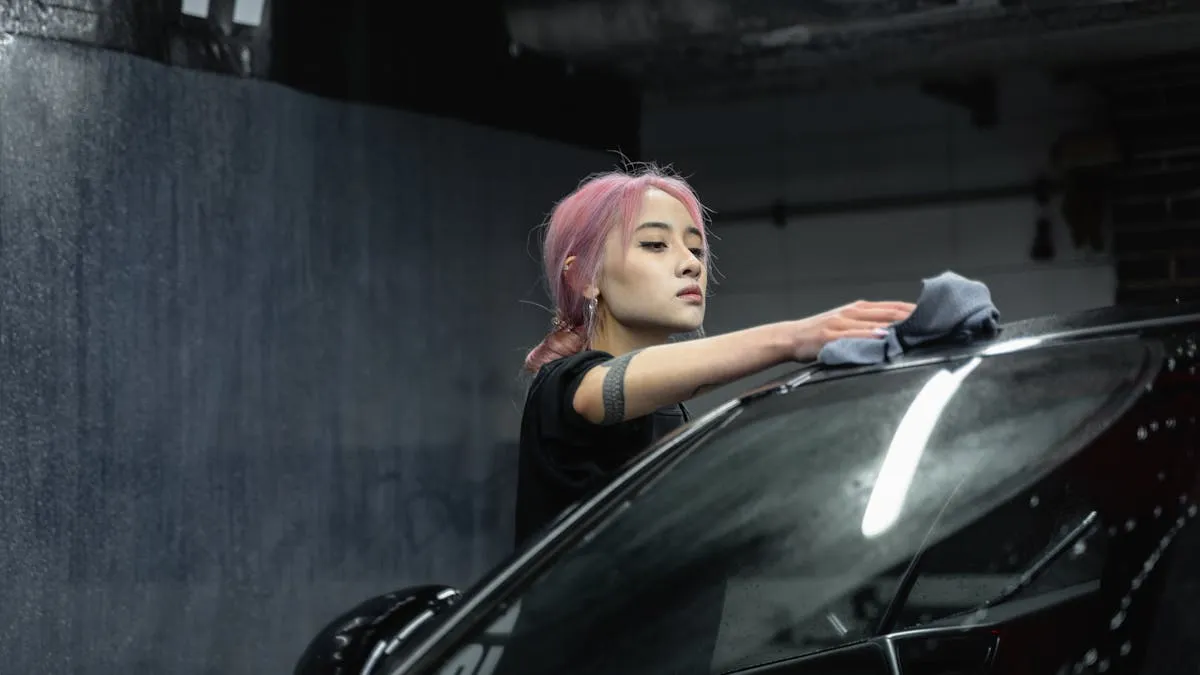
The key is as few passes as possible. Don’t scrub. Lay the towel on the panel, press lightly, and lift. You’re blotting water off the surface, not buffing it dry.
Leaf Blower or Forced Air Dryer
This is the safest method, period. A leaf blower or dedicated car dryer blasts water off the surface without any physical contact with the paint. Zero contact means zero chance of scratching.
Forced air is especially effective for clearing water from crevices — mirrors, door handles, badges, window seals — that towels can’t reach. Those spots drip onto panels as soon as you drive away and leave water spots.
A standard leaf blower works. A dedicated car dryer works better because it typically blows warmer, drier air. Either way, start at the roof and work down, moving water off the panel edges rather than pooling it in one spot.
The air-then-towel approach is the best combination: blow off 80% of the water, then finish with a single-pass microfiber on any remaining drops.
Proper Technique
Work panel by panel. Don’t soap up the whole car, rinse it all, then come back to dry — standing water on paint in direct sun (especially in Texas) will spot. Dry as you go or work in the shade.
Never dry a car that still has dirt on it. If your rinse was incomplete and there’s visible contamination left on the paint, a second rinse pass before drying is mandatory. A towel on a dirty panel is guaranteed scratches.
Use two towels. One for the first heavy pass to absorb bulk water, a second dry one for final finishing. The first towel gets saturated fast.
Start at the top. Roof first, then hood and trunk, then doors, then lower panels. Lower panels collect the most road contamination and should be touched last — or cleaned with a separate dedicated towel.
Coated vs. Uncoated Cars
On a ceramic coated vehicle, water behaves differently. Hydrophobic coatings cause water to bead tightly and sheet off the surface during the rinse itself. On a properly maintained ceramic coating, a leaf blower alone often gets the car 90% dry — the remaining drops are minimal and a single light pass with a clean microfiber finishes the job.
This is one of the practical benefits of a coating that gets overlooked. Faster, safer drying reduces the risk of wash-induced scratches significantly over the life of the vehicle.
On uncoated paint, water sheets less efficiently, so more towel work is required. This makes technique more important and the quality of your drying towel more critical.
If your car has paint protection film, use the same approach — forced air, then microfiber. Avoid any direct scrubbing around film edges, where the adhesive can eventually lift if repeatedly stressed.
What to Avoid
- Chamois (synthetic or natural): These can drag and don’t lift contaminants — they push them around.
- Bath towels, paper towels, or shop rags: Not for paint. Ever.
- Drying in direct sun: Heat accelerates water spot formation and makes panels hot enough to trap contaminants in a soft microfiber.
- Skipping air drying in crevices: That water will drain onto your freshly dried panels within 200 feet.
Getting your drying technique right costs nothing. It’s one of the few things in paint care that requires zero products — just the right tools and the right order of operations.
Keep Your Vehicle Looking Its Best
Why Automatic Car Washes Ruin Paint
What Car Wash Tunnels Do to Your Paint
How to Wash a Ceramic Coated Car