Iron Decontamination: Why Your Paint Needs It Before Any Coating or Polish
If you’ve ever run your hand across a freshly washed car and felt a rough, almost sandpaper-like texture on the paint — even though the car looks clean — that’s iron contamination. It’s one of the most common paint problems most car owners don’t know they have, and it’s one of the most important things to address before any serious paint treatment.
Here’s what it is, how to find it, and what to do about it.
What Is Iron Contamination?
Iron contamination refers to tiny metallic particles that have embedded themselves into your paint’s clear coat. They come from three main sources:
Brake dust is the biggest culprit for most daily drivers. Every time you brake, your rotors and pads shed microscopic iron particles. These particles become airborne, travel backward, and land on your rear wheels, bumper, and lower panels — and in city traffic, they end up all over the car.
Rail dust affects vehicles that were transported by rail before delivery. Trains generate enormous amounts of iron particulate as their wheels grind along steel tracks. Cars sitting in transport carriers absorb these particles and often arrive at dealerships already contaminated.
Industrial fallout comes from manufacturing plants, steel mills, and even heavy highway traffic. If you park near any industrial area or spend significant time on busy freeways, your car is collecting these particles constantly.
The problem isn’t just that they feel rough. Iron particles oxidize once embedded in paint — they rust. That rust reaction causes tiny pitting in the clear coat over time, creates orange or brown speckling visible under harsh lighting, and most importantly, creates a barrier that prevents coatings and polishes from bonding properly to the surface underneath.
How to Spot Iron Contamination
The easiest test is the plastic bag test: put a clean plastic bag over your hand and run it across a freshly washed panel. If you feel texture — like running your fingers over fine sandpaper — that’s contamination. A properly decontaminated surface should feel completely smooth and glassy.
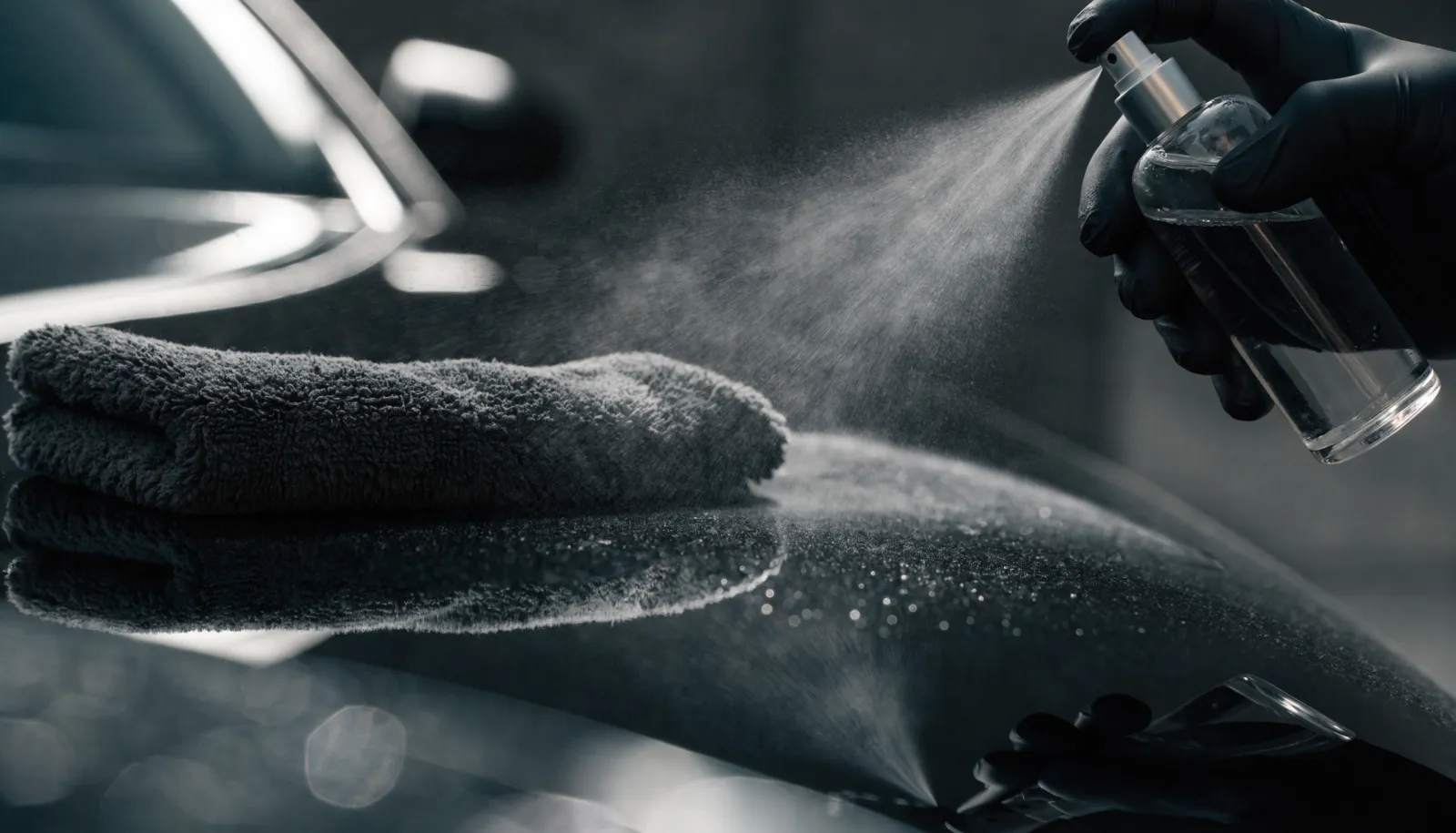
You can also use a dedicated iron remover spray. Products designed for this purpose contain a chemical called ammonium thioglycolate (or similar iron-reactive compounds) that react with iron particles and turn purple on contact. Spray it on a clean panel, wait two to three minutes, and watch for the color change. Purple streaks and dots appearing before your eyes — especially on wheels, lower panels, and any horizontal surface — are iron particles reacting with the product.
Under harsh direct lighting like a detail flashlight, you may also see tiny brown or orange specs on lighter-colored paint. These are particles that have already started to rust.
Why Iron Must Come Out Before Coating or Polishing
This is the part that matters most for anyone considering ceramic coating or paint correction.
Ceramic coatings chemically bond to the clear coat surface. If that surface has embedded iron particles sitting in it, the coating bonds over the contamination, not to clean paint. The result: you’ve locked iron into the paint under a layer of ceramic. Over time those particles continue to oxidize, and you get premature coating failure, clouding, or brown spotting — problems that are difficult and expensive to address after the fact.
Paint polishing has a similar problem. Polishing over contamination means you’re running a polishing pad across embedded metal particles. Those particles act as abrasives that cause additional marring. You end up working against yourself, creating new scratches while trying to remove old ones.
Professional detailers run a decontamination step on every single job — not because it looks good on a service menu, but because skipping it produces objectively worse results. At EuroLuxe, no coating goes on without it.
How Iron Removers Work (The Chemistry)
Iron removers work through a chelation reaction. The active chemical compound (typically ammonium thioglycolate or sodium thioglycolate) binds to iron oxide — essentially grabbing onto the rust molecules — and converts them into a water-soluble compound that can be rinsed away.
This is why you see the purple color change: it’s a visual indicator that the chemistry is working and iron is present. The reaction happens at room temperature and is safe for clear coats when used as directed (don’t let it dry on the surface, and don’t use it in direct sun).
After an iron remover, the particles are chemically dissolved and loosened from the clear coat. A thorough rinse removes them from the surface entirely.
When to Use a Clay Bar Instead
Iron removers handle dissolved and loosened contamination but they don’t physically pull particles from the surface. That’s where a clay bar comes in.
A clay bar is a pliable compound that mechanically drags surface contamination off the paint. It’s effective on larger embedded particles, tree sap, road tar spots, and any remaining contamination after an iron remover treatment.
The proper sequence on a heavily contaminated car:
- Wash the car thoroughly
- Apply iron remover and let it dwell (typically 3–5 minutes, never to the point of drying)
- Rinse well
- Clay bar the entire car with clay lubricant
- Final rinse and dry
On a mildly contaminated car or as regular maintenance, some detail shops skip the clay and use the iron remover alone. But on a car that hasn’t been properly decontaminated in a year or more — or on any car before a paint correction job — both steps are the professional standard.
How Often Should You Decontaminate?
For most daily drivers in the Houston area: once or twice a year is enough. More frequently if you park near rail lines, heavy industry, or brake dust is noticeably bad on your wheels.
After decontamination, if you have a ceramic coating, maintaining that coating properly with the right wash technique and maintenance products will reduce how quickly contamination re-embeds.
If you’re not sure where your car stands, call us at 936-292-6056 — we’ll check it during any appointment and walk you through what the surface actually needs before we touch it with a polisher or coating.
Keep Your Vehicle Looking Its Best
Why Automatic Car Washes Ruin Your Paint
Clay Bar Treatment Explained
Paint Correction Before Ceramic Coating: Why It Matters