What to do with your car after it rains in North Houston
Most vehicle owners treat rain as free car washing. The logic seems reasonable enough — water is water, and if it rinses the dust off, that should count for something. In North Houston, that thinking causes more paint damage than it prevents. The water that falls from the sky here picks up airborne particulates, pollen, and industrial fallout on the way down, then collects road grime and brake dust off the pavement on contact. When it evaporates, it leaves all of that behind, concentrated wherever a droplet sat on your paint.
The problem is compounded by the mineral content in local groundwater. When rain mixes with irrigation overspray or drainage runoff from curbs and driveways, what lands on your paint is not pure rainwater. It is a diluted mineral solution. Once that evaporates under the Texas sun — which can return with full intensity within an hour of a storm passing — the calcium and magnesium compounds bond to your clear coat and begin etching. Left long enough, they become water spots that no simple wash will remove.
Knowing what to do in the hours after rainfall makes a measurable difference in your paint’s long-term condition. The steps are not complicated, but they do require prompt action and the right materials.
Why post-rain contamination is worse than it looks
Rainwater is mildly acidic to begin with, typically falling between 5.0 and 5.6 on the pH scale. In areas with higher air pollution — and the Houston metro qualifies — that number drops further as sulfur dioxide and nitrogen oxides dissolve into droplets during descent. The result is a slightly acidic solution sitting on your paint surface. On bare or wax-only paint, that begins attacking the clear coat immediately on contact.
On top of the acidity, any iron particles, brake dust, or industrial fallout suspended in the air get carried to your car’s surface by rain. These particles embed into paint and begin oxidizing almost immediately, especially in warm, humid conditions. You may not see them, but they are there — and they accelerate surface degradation with every storm cycle.
If your vehicle sits overnight after a heavy rain without being addressed, those compounds have hours to bond to the surface. The longer they sit, the harder they are to remove without abrasive intervention.
What to do in the first hour after rain
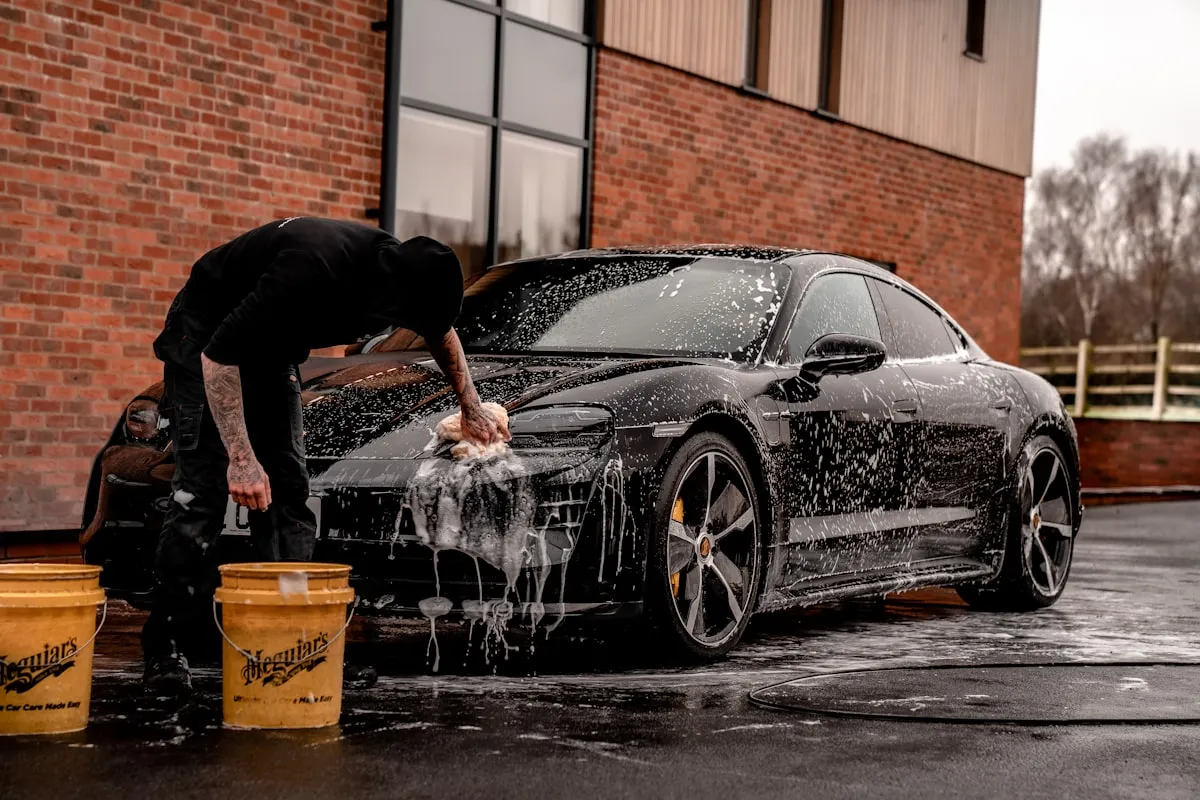
The most effective thing you can do after rain stops is rinse your vehicle with clean water and dry it properly before the residue has a chance to dry on the surface. A garden hose with adequate pressure works for this if you do not have access to a foam cannon setup. The goal is to dilute and displace what the rain deposited before it concentrates.
After rinsing, drying is the step that most owners skip or rush. Letting your car air-dry after a rain rinse is no different than letting it air-dry after a wash — you are giving every remaining droplet the chance to leave a mineral deposit. Use a clean, high-quality microfiber drying towel or a forced-air blower to remove water from flat panels, crevices, mirrors, and door handles before it evaporates on its own.
If you cannot do a full rinse-and-dry in that window, a detailing spray or quick detailer applied to a damp surface and wiped off with a clean microfiber can buy you some time by encapsulating the surface contamination and making it easier to remove. This is not a substitute for a proper wash, but it is better than doing nothing.
How protective coatings change the equation
A quality ceramic coating fundamentally changes how rain interacts with your paint. The hydrophobic layer causes water to bead tightly and sheet off at speed, which means far less water sits on the surface to begin with. Mineral deposits do not bond to a properly maintained ceramic surface the way they do to bare or waxed paint, and when water spots do form, they are almost always surface-level and addressable with a properly pH-balanced maintenance wash rather than abrasive correction.
That advantage is not passive, though. A ceramic coating that is not maintained — one with surface contamination, depleted boosters, or degraded hydrophobicity — does not perform like a fresh coating. The post-rain care steps outlined here apply to coated vehicles as well. Rinsing and drying promptly extends the effective life of the coating by preventing bonded contamination from degrading the top layer.
For vehicles that sit outside regularly in North Houston, the combination of a ceramic coating and disciplined post-rain washing keeps paint in correctable condition far longer than either approach alone.
Dealing with water spots that have already formed
If water spots have already dried and etched into your paint, rinsing and wiping will not remove them. Freshly dried spots — those that formed within the last day or two — often respond to a dedicated water spot remover, which is a mildly acidic or chelating solution designed to dissolve mineral deposits without abrading the surface. Apply it to a cool, shaded panel, allow brief dwell time, and remove it with a clean microfiber. Do not let it dry on the surface.
Older or more deeply etched water spots require more aggressive intervention. At a certain depth, the mineral deposit is no longer just sitting on the clear coat — it has physically altered the surface topography. Those require machine polishing to level the surrounding clear coat and restore a uniform surface, which falls under paint correction. This is worth understanding before you reach for a compound at home, because improper abrasive use on already-thinned clear coat causes more damage than the spots themselves.
If you are not sure whether a water spot is surface-level or etched, look at it from a low angle in natural light. A surface deposit looks hazy but flat. An etch will have a visible ring or indent in the surface. When in doubt, have a professional assess it before attempting any abrasive treatment.
Building post-rain habits into your routine
The vehicles that hold their paint quality over years of North Houston ownership are not the ones that get the most elaborate treatments — they are the ones whose owners respond quickly and consistently to the small things. Rain is not avoidable. Letting its deposits sit and harden is a choice. A quick rinse and dry after a storm takes fifteen minutes and costs nothing beyond the effort. Over a two- or three-year period, that habit is the difference between paint that needs a light maintenance polish and paint that needs a stage-two correction before it can hold a coating.
If you have questions about your vehicle’s current paint condition or what level of protection is appropriate for how and where you park, reach out to EuroLuxe Detailing at (936) 292-6056. Every paint situation is different, and a brief conversation is usually enough to give you a clear direction.
Post-rain care is unglamorous work, but so is most of what keeps a vehicle looking the way it should. The owners who understand that rarely need the expensive corrections that others end up paying for after ignoring a few too many storms.