How to remove contaminants from car paint safely
Most vehicle owners wash their cars regularly and assume a clean surface means a safe surface. It does not. Paint contamination is a separate problem from dirt, and it does not rinse away with soap and water. Rail dust, iron fallout from brake particles, industrial overspray, tree sap, tar, and embedded road grime all bond chemically or mechanically to your clear coat. Left in place, they accelerate paint degradation, make future scratches more likely, and — if you apply a ceramic coating or paint protection film over them — get sealed in permanently. Understanding what these contaminants are, how to identify them, and how to remove them correctly is foundational car care, not an advanced technique reserved for professionals.
North Houston’s driving environment makes this topic particularly relevant. Commuters running US-249 and the Grand Parkway pick up brake dust and road tar constantly. Parking near construction zones — and there is no shortage of those in Tomball, Conroe, and The Woodlands — introduces industrial particles that carry iron and other metals. Pollen in spring and summer can trap moisture against the clear coat and accelerate oxidation when not removed promptly. This is not a climate where you can ignore decontamination and expect your paint to stay clean in any meaningful sense.
The good news is that a proper decontamination process is methodical, not complicated. It breaks into distinct steps that address different types of contamination, and none of them require aggressive compounds that risk damaging the clear coat if done correctly.
Understanding what is actually on your paint
Iron fallout is the most common and least visible contaminant. Brake dust from your own vehicle and from surrounding traffic is constantly in the air, and iron particles embed themselves into paint and clear coat at the molecular level. You cannot see individual particles, but when you run an iron decontamination product over the surface and watch it turn purple, the chemical reaction makes the invisible visible. Left in place, iron particles oxidize and create microscopic rust blooms that roughen the surface and dull the finish over time.
Tar and road adhesive are common on lower panels and rockers, especially after summer road repairs when fresh asphalt is being laid across Harris and Montgomery counties. These appear as small black dots or streaks, and they are adhesive — they do not respond to normal car wash soap. Tree sap varies in viscosity depending on the season, and fresh sap is much easier to remove than sap that has hardened and UV-cured against the paint over several weeks. Industrial overspray from nearby construction or painting operations is a subtler problem, showing up as a rough, almost sandpaper-like texture across the top horizontal surfaces.
The tactile test and what it tells you
Before any decontamination work, wrap a clean microfiber towel around your hand and slowly drag it across a recently washed and dried panel. A clean, uncontaminated surface feels smooth and almost frictionless. What you will usually find instead is a gritty, rough texture — like the feel of fine sandpaper. That is embedded contamination the wash did not touch. The roof, hood, and trunk lid usually show it most clearly because those horizontal surfaces collect and hold fallout differently than vertical panels.
This test tells you two things: whether decontamination is needed (it almost always is on a vehicle older than a few months), and roughly how severe the contamination is. A mildly rough surface can be addressed with chemical decontamination alone. A significantly rough surface — one that feels coarse even after chemical treatment — indicates that clay bar or a clay substitute will also be needed to mechanically lift the remaining bonded particles.
Chemical decontamination first, mechanical second
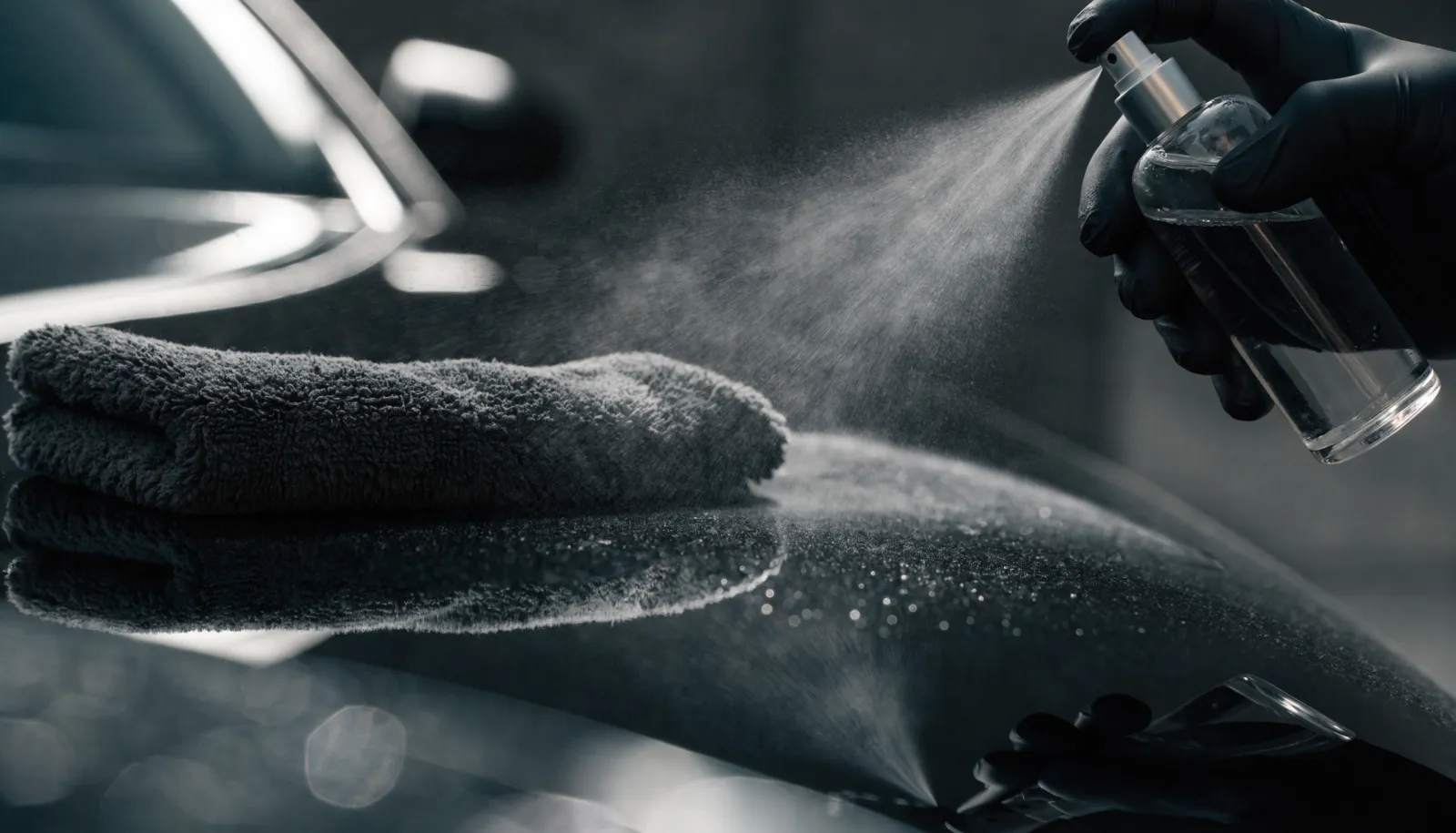
The correct sequence matters. Start with a pH-neutral car wash to remove loose surface dirt. Then apply an iron remover — a spray product that reacts chemically with ferrous particles and breaks their bond to the surface. Let it dwell for the time specified on the product, watch for the purple color change that confirms the reaction is working, then rinse thoroughly. Follow that with a tar and adhesive remover for any visible tar spots, working panel by panel with a clean microfiber applicator.
Once the chemical step is complete, re-rinse the vehicle and inspect the surface again with the towel test. If roughness remains, clay work is the next step. Clay bars and clay mitts both work by mechanically shearing off bonded contamination that chemical products alone cannot lift. The critical requirement here is lubrication — a proper clay lubricant or a quick detailer spray applied generously as you work. Clay used on a dry surface will cause the very marring you are trying to prevent. Work in small sections, use light overlapping strokes, and fold or flip the clay frequently to expose a clean surface. When finished, the paint surface should feel noticeably smoother and more consistent.
If you are considering a ceramic coating or paint protection film installation, decontamination is not an optional step — it is mandatory. Coating products bond to the clear coat, and any contamination sitting beneath them gets sealed in. At EuroLuxe, full chemical and mechanical decontamination is part of every coating prep process for exactly this reason.
Maintenance decontamination between major services
Full decontamination is not something most owners need to do every month, but incorporating an iron rinse into a quarterly routine makes a meaningful difference, particularly on vehicles that park outside or commute on heavy-traffic roads. Some maintenance wash products include mild iron-chelating agents that provide partial protection with every wash. These do not replace a proper full decontamination service, but they slow the accumulation rate.
For ceramic-coated vehicles, decontamination is even more important because the coating’s hydrophobic properties, while excellent at repelling loose dirt and water, do not prevent iron fallout from embedding in the coating layer itself over time. An annual iron decon treatment keeps the coating performing at its designed level and extends the interval before the next paint correction would become necessary. If the coating itself shows signs of failing — water behavior degrading, surface feeling rough again despite washes — a professional inspection should be the first step before any product application.
What to avoid and when to call a professional
A few practices cause more harm than the contamination they are meant to address. Household degreasers and dish soap strip paint sealants, damage rubber trim, and leave no lubrication for claying. Abrasive scrub pads, even the ones marketed for automotive use, can leave scratches that require correction to remove. Pressure washing at very close range can force contaminants into the clear coat rather than lifting them out, and at extreme angles it can lift edges on any existing protective film.
When the contamination is severe — deep tar saturation across multiple panels, water spot etching from hard water or acid rain, or surface roughness that persists through multiple clay passes — the situation has moved into paint correction territory. Trying to clay or chemically treat etched clear coat does not fix the damage; it just cleans around it. At that point, the correct path is a professional assessment and a polishing step before any protective layer goes on.
If your paint feels rough after washing and you are not sure what you are dealing with, or you are planning to coat or film the vehicle and want the surface done correctly, reach out to the team at EuroLuxe at (936) 292-6056 to schedule an inspection.
Decontamination is one of the least visible steps in vehicle care, which is part of why it gets skipped. But every coating, every film, and every layer of wax or sealant performs exactly as well as the surface beneath it — not better. Getting that surface clean, chemically and mechanically, is what makes the rest of the work hold.