Washing your car in hard water areas: what North Houston owners need to know
Most of North Houston sits on water supplied by the Gulf Coast Aquifer system or surface sources blended with municipal treatment. The result is water with measurable hardness — calcium and magnesium concentrations high enough to leave mineral deposits on paint within minutes of exposure if the water is not removed before it dries. This is not a cosmetic nuisance. Repeated mineral etching eventually degrades clear coat, and once the damage is structural, washing alone will not fix it.
The problem compounds in summer, when ambient temperatures regularly push into the mid-90s and surfaces heat far beyond that. Water evaporates faster than you can rinse a panel, concentrating minerals in place. What looks like a light haze on a freshly washed car often turns out to be weeks of accumulated deposits that require decontamination or, in worse cases, paint correction to address. Understanding why this happens — and adjusting your wash process accordingly — prevents most of it.
This is not a guide for show cars stored under climate control. It is a practical walkthrough for daily drivers and weekend vehicles parked in driveways across The Woodlands, Tomball, Cypress, Spring, and Conroe, where owners wash their own vehicles regularly and want to do it without creating new problems.
Why hard water leaves spots even after a thorough wash
Water hardness is measured in grains per gallon or parts per million of dissolved calcium carbonate. Much of the North Houston metro falls in the moderately hard to hard range. When water evaporates, the minerals it carried do not evaporate with it — they stay on the surface and bond lightly to the paint or coating below.
Fresh deposits wash off easily. Old deposits, especially those that have been baked by direct sun across multiple heat cycles, begin to chemically bond with the clear coat surface. At that stage, you are dealing with mineral scale, not simple dirt. A regular wash will move the scale around but will not lift it. Dedicated water spot removers or a fallout decontamination step are required, and if the mineral has physically etched into the clear coat, mechanical correction becomes the only option.
The irony is that washing your car frequently in hard water without the right technique can accelerate the damage you are trying to prevent. Each wash that leaves standing water on a hot panel adds another layer of concentrated minerals.
Adjusting your wash process for hard water conditions
The most important variable is time and sequence. Do not start washing a vehicle that has been sitting in direct sun. Surface temperatures can exceed 140 degrees on dark paint. Wash in shade or during cooler parts of the day — early morning is ideal in North Houston summers, as temperatures and humidity are more manageable before 9 a.m.
Work one panel at a time and rinse each panel immediately after washing it. Do not soap the entire car and then rinse — in hard water and heat, the rinse water left sitting on a panel you finished two minutes ago is already concentrating. Rinse as you go, staying ahead of evaporation.
A low-pressure rinse that maintains a sheet of water across the panel surface — rather than a hard stream that breaks into droplets — reduces spotting because sheeting water carries minerals off the surface rather than beading them in place. Adjust your nozzle accordingly.
The drying step is where most damage actually happens
A large percentage of hard water spotting occurs not during the wash itself, but during drying. Leaving water on the surface while you move to the next panel, or air-drying because you ran out of time, deposits minerals exactly where they will be most difficult to remove: on paint you just cleaned.
Dry with a quality microfiber waffle-weave drying towel or a forced-air blower. If you use towels, use multiple — saturated towels do not absorb efficiently and can drag mineral-laden water across the surface rather than lifting it. Blowers are preferable for crevices and panel gaps where water pools and then drips onto dry paint minutes after you have moved on.
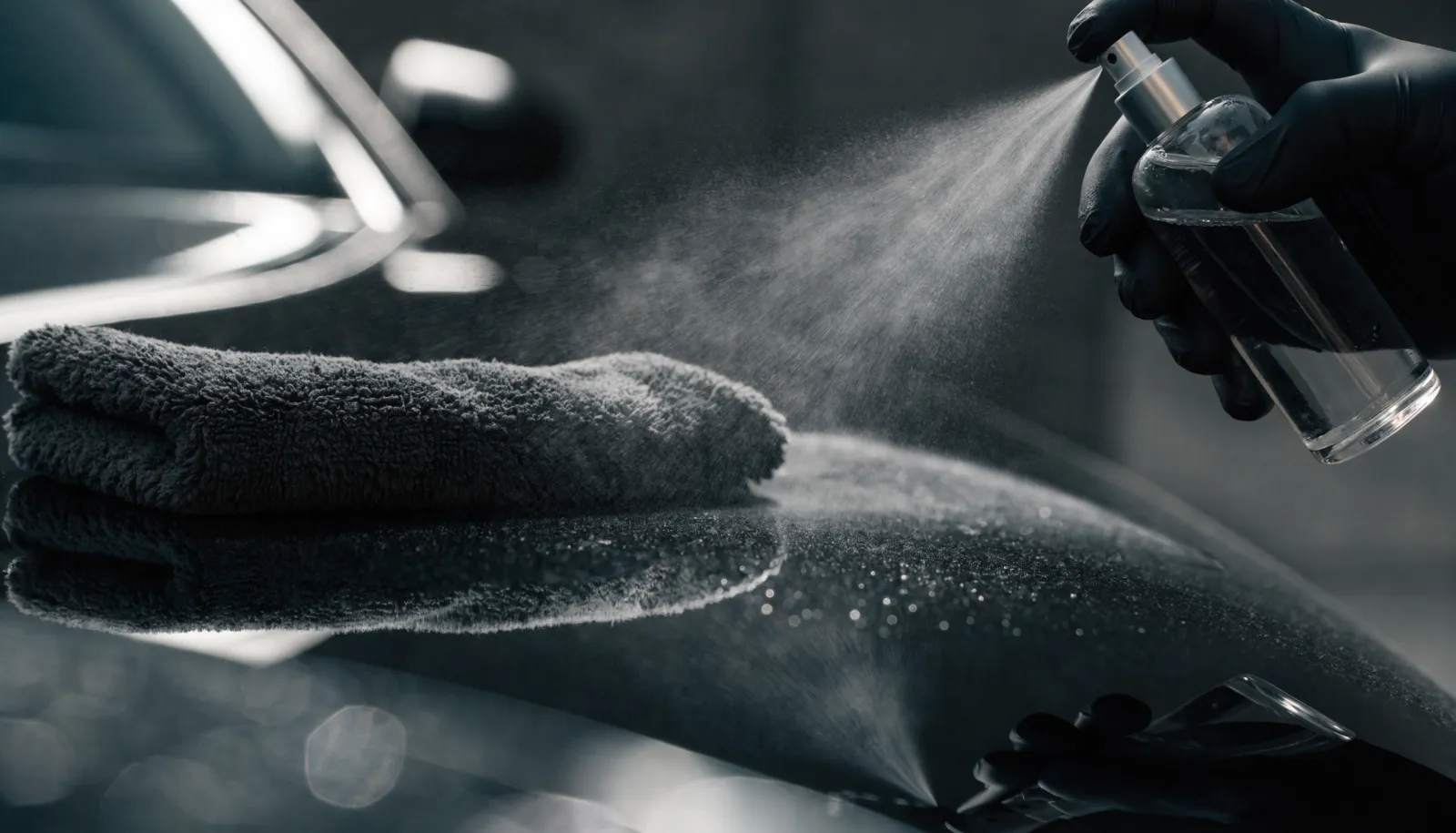
A light spray detailer or quick detailer product applied during drying serves two purposes: it lubricates the towel to reduce marring, and it dilutes the mineral concentration in remaining water, making spots less likely to form and easier to wipe away if they do. Use a product designed for your paint surface — if the vehicle has a ceramic coating, use a coating-compatible spray rather than a wax-based detailer, which can interfere with the coating’s chemistry.
Using a water softener or deionized rinse
For owners who wash frequently and live in particularly hard water zones, an inline deionizing filter is a practical investment. These devices attach between your garden hose and your wash nozzle and remove dissolved minerals before the water reaches the car. A proper deionized rinse produces water that is functionally spot-free even without immediate drying, because there are no minerals left to deposit.
Deionizing filter cartridges exhaust over time based on the volume of water run through them. In a hard water area, plan on replacing or regenerating the resin cartridge periodically — the manufacturer’s gallon capacity estimate assumes average hardness, and North Houston water often reduces effective life. Test the output with a TDS (total dissolved solids) meter; when readings climb above 10 ppm, the cartridge is no longer providing meaningful protection.
Softened water from a home water softener is not an equivalent substitute. Softening replaces calcium and magnesium with sodium, which evaporates more readily than calcium but is not chemically inert — sodium deposits on paint still require rinsing. Deionized or reverse-osmosis water is the appropriate choice for a spot-free final rinse.
When washing is no longer enough
If you are already looking at a vehicle with existing hard water etching — a whitish haze, ring-shaped deposits, or surface texture that was not there before — washing will not resolve it. Light deposits that have not etched into the clear coat can often be addressed with a dedicated water spot remover applied by hand. These products use mild acids to dissolve calcium carbonate without harming clear coat when used as directed.
Deeper etching that has physically altered the surface texture requires mechanical paint correction. The correction process removes a controlled amount of clear coat to bring the surface level back below the damage. This is not something to approach casually — incorrect technique or excessive correction on already-thin clear coat causes permanent thinning. A professional assessment of paint thickness before any correction work is standard practice at a reputable shop.
If your vehicle is located in North Houston and you are uncertain whether what you are seeing is removable contamination or actual etching, a paint inspection before committing to any treatment is worthwhile. EuroLuxe Detailing can be reached at (936) 292-6056 to discuss what you are seeing and what the appropriate next step would be.
Building a routine that holds up over time
The vehicles that hold paint condition longest in this climate are typically those where the owner has established a consistent, methodical wash routine — not necessarily an expensive one. Washing in shade, working panel by panel, drying immediately, and doing a full decontamination wash every few months removes the cumulative buildup before it bonds permanently. Combine that with a protective coating or sealant and the surface becomes more forgiving: water beads and sheets more readily, minerals have less surface contact, and the protective layer takes the chemical burden rather than the paint itself.
Hard water is a fixed variable in North Houston. Adjusting your technique around it is not complicated, but it does require intention — something most of the common advice about car washing skips past entirely.