
How North Houston summers damage car paint and what to do about it
Most people understand in a general way that heat is hard on a car. What they underestimate is how specific the conditions are here in the greater Houston area, and how compounding those conditions become when a vehicle parks outside every day from May through September. This is not a southern California dry-heat situation. North Houston brings high UV index, humidity levels that routinely sit above 70 percent by 9 a.m., road debris from rapidly expanding construction corridors, and afternoon thunderstorms that deposit acid-laden water onto paint and then bake it dry within the hour. Each of those factors does damage independently. Together, they accelerate paint degradation faster than almost any other environment in the country.
For owners in The Woodlands, Tomball, Cypress, Conroe, Kingwood, Spring, and the surrounding communities, this is not a hypothetical concern. It is something visible on any used car lot: oxidized hoods, chalky clear coat, water-spot etching on trunk lids, and faded plastic trim on vehicles that are only four or five years old. Understanding the mechanisms makes the prevention straightforward.
What UV actually does to automotive clear coat
Clear coat is the sacrificial layer that sits over your base coat and gives the finish its depth and gloss. It is not glass. It is a polyurethane or acrylic polymer, and UV radiation breaks the molecular bonds within it over time. This process is called photodegradation, and it is the direct cause of oxidation — that flat, chalky, milky appearance that develops on neglected vehicles.
Houston averages over 200 sunny days per year, and the UV index regularly peaks at 10 or 11 during summer months. A car parked outside five days a week accumulates UV exposure faster than the clear coat’s original formulation was engineered to withstand without supplemental protection. The roof, hood, and trunk lid take the most direct radiation and are almost always the first panels to show oxidation.
Once the clear coat oxidizes past a certain depth, it cannot be restored with polish alone. Paint correction can remove the damaged material down to healthy clear, but only if enough thickness remains. A paint thickness gauge will tell you what is there. If the clear coat is already at minimum thickness across a panel, the only real option is a repaint.
How humidity and heat cycles break down paint faster
Temperature swings cause automotive materials to expand and contract. In North Houston, the swing from an air-conditioned garage or parking structure to direct afternoon sun can represent a surface-temperature change of 60 to 80 degrees Fahrenheit on a dark-colored vehicle. Clear coat, primer, and sheet metal all have different thermal expansion coefficients. That repeated stress creates micro-fractures at the molecular level long before anything is visible to the eye.
Humidity compounds this because water infiltrates those micro-fractures. When that water contains airborne pollutants — and Houston’s air does, given the concentration of petrochemical industrial facilities to the south and east — you have a mild acid in contact with the base coat. Add heat, and the chemical reaction accelerates. This is why vehicles that sit outside in Houston consistently degrade faster than the same model year vehicles in lower-humidity climates, even when both receive comparable sun exposure.
Rain does not rinse the paint clean. Rainwater collects airborne particulates, industrial fallout, and biological material as it falls and as it pools on body panels. When it evaporates, it leaves those contaminants behind, concentrated, on the paint surface.
Road conditions specific to North Houston that add physical damage
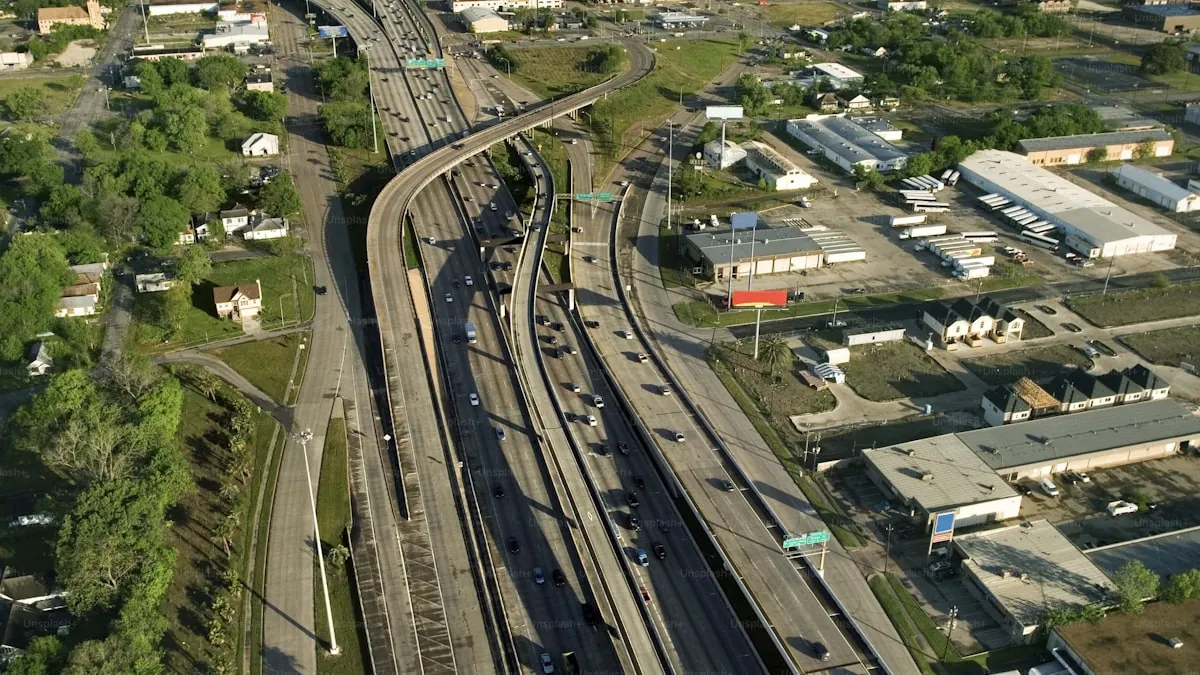
The Grand Parkway expansion, ongoing development along FM 2920, SH 249, and throughout the 99 corridor has meant years of construction traffic, loose aggregate, and freshly paved roads that shed tar and gravel at highway speeds. A drive from Tomball to The Woodlands on any given weekday exposes a vehicle’s front end to dozens of small impacts that standard paint cannot absorb without chipping.
Chips and road rash matter beyond appearance. Each break in the clear coat and base coat is a path for moisture to reach the primer and bare metal underneath. In Houston’s humidity, rust initiation at a chip site can begin in a matter of months. Lower rocker panels and front bumpers on unprotected daily drivers in this area show this pattern clearly — scattered chips, each developing a rust halo around the edge.
For vehicles driven regularly on these corridors, paint protection film is the most direct answer to physical impact damage. A quality TPU film absorbs stone strikes and road debris without transmitting the impact to the paint underneath. It also provides a degree of UV resistance on top of whatever protective stack is already in place.
What protection actually works in this climate
The honest answer is that no single product solves every problem. The most durable outcomes come from layering the right products in the right sequence.
Paint correction addresses existing defects — swirl marks, light scratches, water-spot etching, and early oxidation — before any protective coating goes on. Applying a coating over compromised paint locks the defects in and reduces the coating’s ability to bond properly. If your vehicle has visible swirling under direct light, that work needs to happen first.
A professional-grade ceramic coating applied over corrected paint provides the most practical daily protection against UV, chemical fallout, and water-spot formation. A properly cured ceramic layer raises the surface energy of the paint, causing water to bead and sheet off rather than dwell and evaporate. It also provides a sacrificial hardness layer above the clear coat that resists light chemical etching from bird droppings, tree sap, and industrial fallout — all common in this region.
For areas of the vehicle that take physical road impact — hood, front fenders, side mirrors, rockers — combining film with ceramic on the rest of the vehicle is the full-coverage approach that professionals recommend for vehicles driven hard in this area.
Maintenance habits that matter between services
Protection only works if the maintenance routine supports it. In North Houston, that means washing more frequently than most owners expect. During summer months, bird droppings, tree sap from the region’s dense pine and oak canopy, and pollen all deposit heavily. Any of these left on paint or ceramic coating for more than a day or two in high heat can etch through the protective layer and into clear coat.
The two-bucket hand wash method, using a quality pH-neutral soap, remains the safest approach for coated vehicles. Automatic tunnel washes with rotating brushes introduce swirl marks and can lift film edges. Even touchless tunnel washes use high-concentration alkaline or acidic chemistries that degrade ceramic coating over time with repeated use.
A spray sealant or ceramic booster applied after washing every four to six weeks extends coating performance meaningfully. It is a small time investment relative to the protection it maintains.
For owners who cannot commit to frequent hand washing, parking in a garage or under a covered structure overnight at minimum dramatically reduces cumulative UV and contaminant exposure. It is not a substitute for protection products, but it is one of the highest-impact habits a vehicle owner can adopt in this climate.
Getting the right starting point for your vehicle
Before recommending any specific service, a qualified installer will assess the current condition of the paint — its thickness, existing defects, and whether any prior coatings or sealants are present. This matters because the prep required for a two-year-old daily driver with visible swirling is different from a new car with dealer-applied wax still on the surface.
If you are evaluating protection options for a vehicle based in the Tomball, Spring, Cypress, or Woodlands area, the practical conversation starts with an honest condition assessment and a discussion of how you use the car. Reach EuroLuxe Detailing at (936) 292-6056 to talk through what your vehicle’s paint actually needs before committing to any specific service path.
The climate here is not forgiving to paint that is left unprotected, but the damage is largely preventable with the right approach and a consistent maintenance habit. Understanding what is actually happening at the paint surface level makes those decisions easier to prioritize.