PPF edges: why they lift, peel, and how to prevent it
Paint protection film is a long-term investment, and most owners expect it to perform quietly in the background for years without needing attention. In practice, the single most common complaint after installation is an edge that begins to lift — usually on the hood, bumper corners, or door edges — sometimes within months of the job being done. That failure is rarely a film defect. It is almost always a function of surface preparation, installation technique, or aftercare habits.
Understanding what causes edge failure helps you evaluate installer quality before you commit, care for your film correctly after the job, and recognize early signs of a problem before it spreads. A small lifted edge that gets addressed within a few weeks can often be re-tucked or spot-repaired. One that is ignored for a season typically means that section needs to come off.
This guide covers the mechanical reasons PPF edges fail, what separates installations that hold for seven-plus years from those that start lifting at eighteen months, and what you can do to extend the life of your coverage.
Why edges are the hardest part of any PPF installation
The flat center of a panel is the easiest part of a film job to execute well. The adhesive bonds across a clean, stable surface with minimal stress on the film. Edges are different. Every edge — whether it is a panel edge where the film is tucked behind a gap, or a cut line in the middle of a panel — is a point where the film terminates and the adhesive is exposed to the environment.
At a cut line, the adhesive bead along that edge is constantly exposed to wash water, road spray, car wash brushes, and temperature cycling. Thermoplastic urethane expands and contracts with heat. In North Houston, that means the film on a dark hood can reach surface temperatures above 160°F in a Texas summer and then contract again overnight. Every cycle puts mechanical stress on the adhesive at the edge.
Panel wraps — where the film is stretched around a corner and adhered to the backside or tucked into a gap — handle thermal cycling much better than cut lines because the adhesive is protected from direct exposure. Skilled installers choose wrap points strategically for this reason.
Surface preparation directly determines edge adhesion
If the paint surface under the film edge is not fully decontaminated and clean, the adhesive is bonding to whatever contamination is present rather than to the paint itself. Iron fallout, bonded road tar, wax residue, and polish oils all reduce adhesive contact strength. The adhesive may look fine during installation and still fail within a year because it never had a clean foundation.
Proper prep before a paint protection film installation includes a full wash, iron decontamination with a chemical fallout remover, clay bar treatment, and a final wipe-down with an IPA solution to eliminate any remaining polish or wax residue. Skipping any of these steps leaves contamination under the film. You cannot see it after the film goes down, but the adhesive can feel it.
Paint correction, when needed, should always happen before PPF goes on. If the clear coat has swirls, oxidation, or micro-marring, the film seals those defects in permanently and reduces adhesive contact area wherever the surface is irregular.
What installer technique does to edge longevity
An experienced installer knows that how a film edge is terminated matters as much as whether the cut is clean. Several technique factors directly affect how long an edge holds.
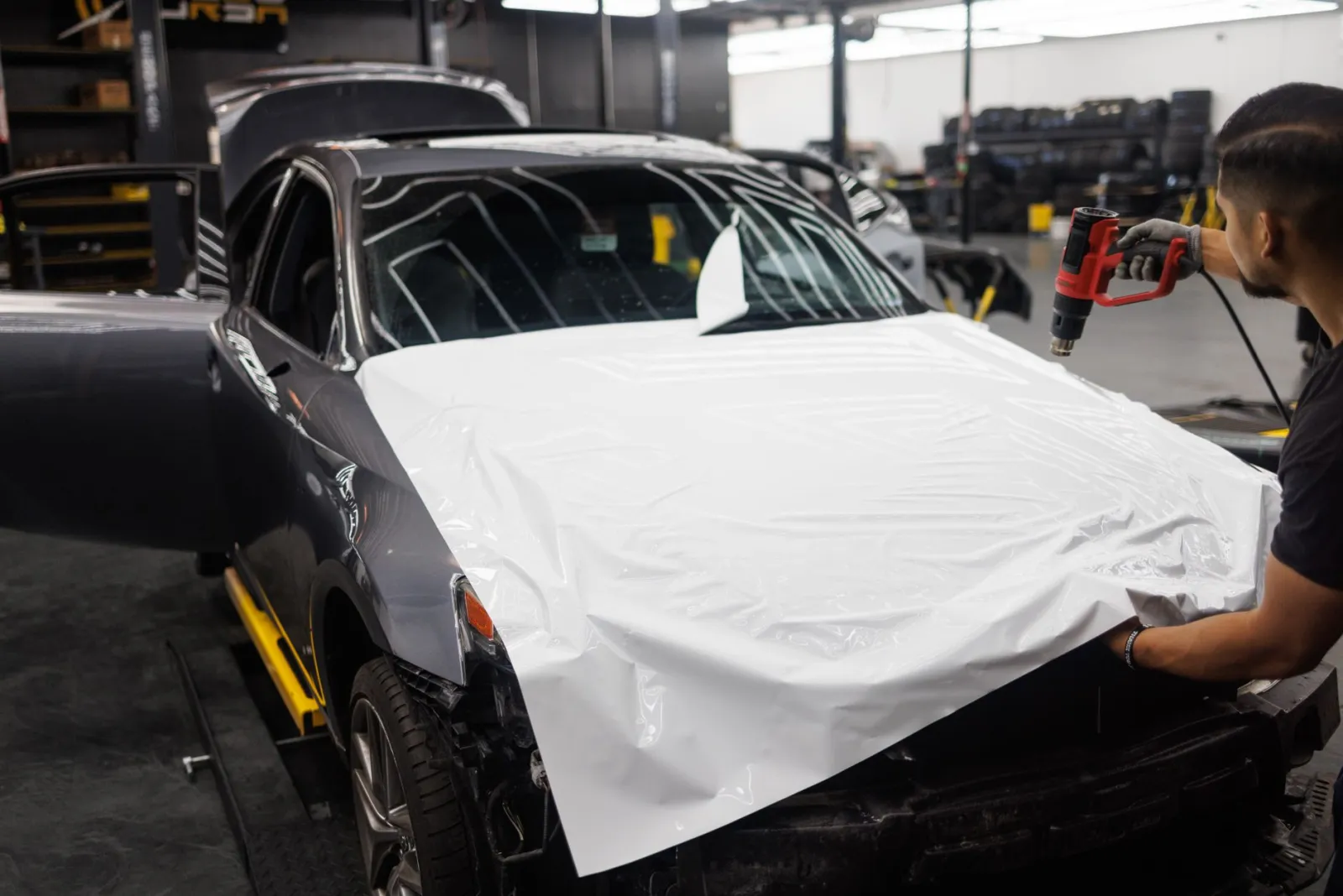
Adhesive activation at edges requires adequate pressure and heat during installation. The squeegee pass that bonds the film has to be applied all the way to the cut line, not stopped short of it. Installers working quickly sometimes under-press edges to avoid sliding the film out of position on complex curves, which leaves the adhesive partially unbonded from the start.
Cut line placement also matters. Placing a cut line directly over a character line, body crease, or area that sees concentrated wash-water runoff shortens edge life. A better cut location might be slightly up the panel where the surface is flatter and the water runs off rather than channels.
Installation environment plays a role as well. Film applied in high humidity struggles to bond properly because the slip solution trapped under the film takes longer to evacuate, and if the installer proceeds too quickly, moisture remains at the adhesive interface. EuroLuxe installs film in a climate-controlled bay specifically to remove humidity and temperature as variables. Controlled conditions are not a luxury on a long film job — they are a prerequisite for consistent edge adhesion.
How aftercare habits accelerate edge failure
Once the film is installed and cured, how you wash and maintain the car has a direct effect on edge life. Automatic tunnel car washes are among the fastest ways to lift PPF edges. The brushes and high-pressure arches at the entrance and exit of a tunnel car wash generate lateral forces across the film surface that pull at edges from multiple directions. Even touchless tunnel washes with concentrated nozzle pressure can undercut edges if the nozzle tracks directly across a cut line.
For a vehicle with paint protection film, hand washing remains the safest wash method. If you are using a pressure washer at home, keep the nozzle moving and maintain at least a 12-inch distance from any cut line or wrapped edge. Direct, sustained pressure held close to an edge will work moisture under the film over time.
Do not apply wax or paste sealant over PPF, especially near edges. Wax that migrates under a lifted edge — even a very slightly lifted one — forms a barrier between the adhesive and the paint surface. What started as a one-millimeter lift becomes a two-centimeter bubble within a few wash cycles. If the film over your vehicle is ceramic-coated rather than waxed, keep that coating out of the gap as well; the same principle applies.
Recognizing early signs before a small problem becomes a big one
Edge failures rarely happen all at once. They progress. Catching them early gives you options that disappear once the adhesive fully breaks down or the film begins to delaminate from contamination migrating under the lifted section.
The most common early sign is a very slight lifting at a corner or cut line that you can feel with a fingernail but cannot clearly see from arm’s length. It often appears first at bumper corners, the leading edge of side mirrors, and the rear corners of hoods where water drains during washing. If you run your fingertip along a film edge and feel any separation, take the car somewhere that can evaluate it before it progresses.
Discoloration along an edge — typically a darker or cloudy appearance — means moisture or contamination has migrated under the film. At that point, re-adhesion is not reliable because the surface under the lift is no longer clean. That section generally needs to be removed and replaced.
If you have concerns about film installed elsewhere or film that has been on a vehicle for several years, an in-person inspection gives you a clearer picture than photographs. You can reach EuroLuxe at (936) 292-6056 to schedule an assessment at 11701 Holderrieth Rd in Tomball.
What separates a seven-year installation from a two-year one
Long-lasting PPF comes down to three things executed consistently: clean surface preparation, deliberate installation technique in a controlled environment, and an owner who understands how to wash and maintain the film afterward. None of these is complicated, but all three have to be present. A meticulous installation on a poorly prepped surface fails at the edges. A clean surface and careful prep are wasted if the installer rushes the edge work. And a perfect installation will still lift if the owner runs it through a tunnel car wash every week.
The film itself — a quality thermoplastic urethane like UltraFit — is designed to perform for the long term. Its adhesive system is engineered for years of thermal cycling and UV exposure. The film does not fail on its own. The conditions around it do. Knowing that is the starting point for protecting your investment properly.