PPF film thickness: what the numbers actually mean
When owners start researching paint protection film, most of the early questions center on coverage zones, cost, and brand names. Film thickness rarely comes up until someone starts comparing quotes side by side and notices that different shops use different products with no explanation of why. Thickness is one of the most practical specs in the PPF category, and it affects how a film performs against the impacts it is actually meant to stop.
Most automotive PPF on the market today ranges from roughly 6 to 10 mils thick, where one mil equals one thousandth of an inch. That range sounds narrow, but the performance difference between the low and high end is meaningful when you consider what paint protection film is actually being asked to do. A thinner film may be easier to conform around tight body contours, but it absorbs less impact energy before that energy reaches the paint. A thicker film distributes force across a larger surface area and resists penetration from sharper debris.
Understanding the basics here helps you ask better questions when you are evaluating installers. A shop that cannot explain what they are installing, or why they chose it, is giving you incomplete information.
What film thickness is actually measuring
The mil rating on a PPF product refers to the full laminate stack, which typically includes a cast polyurethane topcoat, a thermoplastic polyurethane (TPU) base layer, an adhesive layer, and a liner. The TPU layer does the majority of the structural work — it is what absorbs and distributes impact and what heals minor surface abrasions when heat is applied. The topcoat provides chemical resistance and the surface gloss or matte finish you see on the car.
When a manufacturer lists a film at 8 mils, the TPU core is not 8 mils on its own. The liner and adhesive are part of that measurement, though they are not contributing to protection once the film is installed. This is worth knowing because two products listed at the same mil rating can have different TPU core thicknesses depending on how thick the adhesive and liner layers are. Industry-standard 8-mil films typically run a TPU core in the range of 6 to 6.5 mils, with the remainder split between adhesive and topcoat.
How thickness interacts with self-healing performance
Self-healing is the property that allows shallow surface scratches in the topcoat to flow back to a smooth state when exposed to heat — from sunlight, warm water, or a heat gun. This behavior is a function of the topcoat chemistry, not the total film thickness, so a thicker film does not automatically mean better or faster self-healing. However, thickness does affect how much of an impact the film can absorb without the damage reaching the self-healing topcoat layer in the first place.
A direct rock strike on a very thin film can transmit enough force to create a pressure mark that pushes through the topcoat and into the TPU core. At that point, self-healing does not apply because the damage is not surface-level. Thicker films are more likely to absorb that energy in the TPU layer itself, leaving the topcoat intact. This is why high-wear areas like the front bumper, hood leading edge, and rocker panels benefit from the thicker end of the product range.
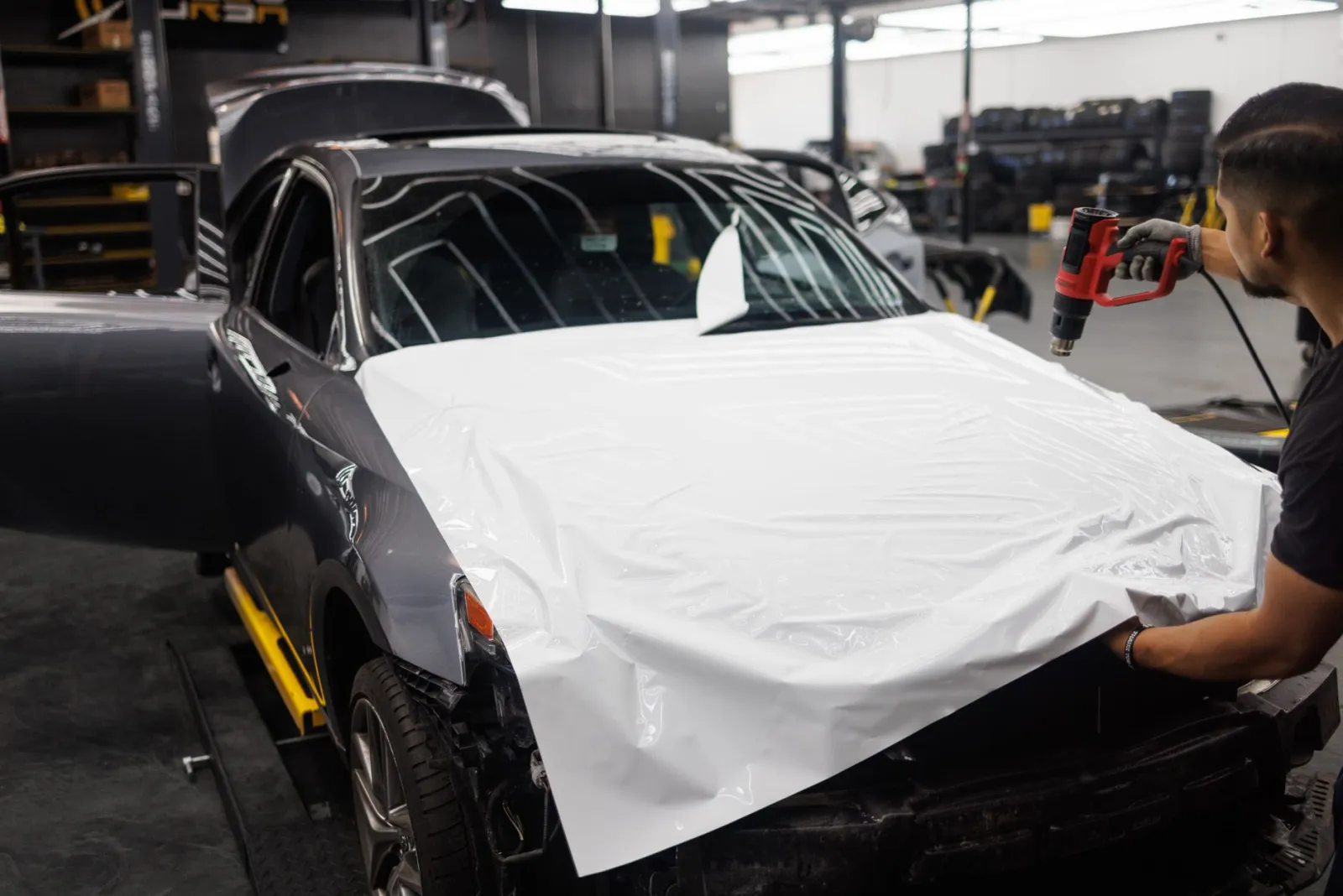
If you are looking at what a quality paint protection film installation looks like in practice, the film spec is part of the conversation that should happen before any cutting begins.
Thickness and conformability: the real trade-off
Thicker film is not always the right answer for every panel. Film that is heavier and stiffer can be harder to wrap cleanly around compound curves, deep recesses, and bumper corners. Installers compensate with heat and technique, but there is a physical limit to how tightly a thick film can be stretched and tucked without creating tension lines, lifting edges, or distortion in the surface.
This is part of why experienced shops often use different products or profiles for different zones on the same car. The hood center and door faces can run a full-thickness protective film without conformability issues. A bumper with aggressive sculpting or a mirror cap with tight radii may benefit from a more pliable film that lays flat without tension. The choice is a balance between maximum protection and a clean, invisible result.
Installers who work with a single film spec across every panel are either simplifying their workflow or limiting your options. Neither is necessarily wrong, but it is worth asking how they handle complex geometry on your specific vehicle.
What UltraFit film specs look like in practice
At EuroLuxe, the PPF product we install is UltraFit. When owners ask why, part of the answer is in how UltraFit balances core thickness with topcoat elasticity. The film is engineered to meet the protection requirements of high-impact zones while remaining workable enough for precise, tension-free installations on complex body panels.
The goal on any installation is a result that looks like the film is not there. That requires a film that conforms without pulling at edges, a topcoat clear enough that the underlying paint color reads accurately, and an adhesive that bonds without trapping contamination or creating optical distortion. Thickness is one variable in that equation, and it has to work alongside every other property in the laminate stack.
If you want specifics on how UltraFit compares to what you may have seen quoted elsewhere, or if you have a vehicle with specific zones you are trying to protect, that is a conversation best had in person. You can also start with our paint protection film page to review coverage options before scheduling.
What to ask before you choose a film
When you are comparing quotes, ask the installer to state the film brand and product name, not just the category. Ask for the listed mil thickness and whether they know the TPU core thickness specifically. Ask whether they use a single product across the entire car or whether they adjust by panel complexity. Ask whether the film is warranted against yellowing, delamination, and cracking, and for how long.
A shop confident in what they install can answer all of those questions without hesitation. If the answer to any of them is vague or dismissive, that tells you something about either the product or the training behind the installation.
Film thickness is not the only specification that matters — adhesive formulation, topcoat chemistry, and how the film handles UV exposure over time are equally important. But thickness is a good starting point because it forces a specific, factual answer that you can compare across options.
If you are working through this process and want a direct conversation about what would make sense for your vehicle, call EuroLuxe at (936) 292-6056. Caleb and the team at 11701 Holderrieth Rd in Tomball work with owners across North Houston to match film selection to actual driving conditions and protection goals — not just to whatever is easiest to install.
The spec sheet on a film tells you what it is made of. The installation tells you what it is worth. Knowing the difference before you commit saves a lot of second-guessing after the fact.