PPF for Electric Vehicles: Rivian, Cybertruck, Lucid, and Beyond
EVs Are Different — and So Are Their Paint Protection Needs
Electric vehicles have fundamentally changed how people buy, drive, and maintain cars. But one thing hasn’t changed: road debris doesn’t care what powers your drivetrain. A rock kicked up on I-45 hits a Tesla Model Y the same way it hits a Camry.
What has changed is the paint. Many EV manufacturers — Tesla being the most notable — use single-stage or thin-application paint processes that are measurably softer and more chip-prone than traditional automotive paint. And because EV owners tend to keep their vehicles significantly longer than gas car owners, the cumulative exposure to highway debris, parking lot incidents, and UV degradation compounds over a longer ownership period.
If you’re driving an EV in North Houston, paint protection film isn’t just a good idea. The math actually works better for you than it does for someone leasing a gas car for three years.
Tesla: The Most Common EV PPF Candidate
Tesla paint quality has been a known issue since the Model S days. The Fremont and Austin factories produce paint that is consistently thinner than industry averages — often measuring 90-100 microns total build (including primer, base, and clear). For comparison, a typical Honda or Toyota runs 120-150 microns.
The result: rock chips happen faster, swirl marks appear more easily, and the clear coat has less margin for error when it comes to paint correction down the road.
Model-Specific Considerations
Model 3/Model Y: These are the volume vehicles. They see daily highway commuting, parking garages, and school pickup lines. The low front end on the Model 3 catches debris at a nasty angle. The Model Y’s broader front profile means more surface area exposed to impacts.
Model S/Model X: Higher price point, softer paint, and owners who tend to keep these for 200,000+ miles. Full front PPF is the baseline recommendation. The falcon wing doors on the Model X create additional edge areas that benefit from protection.
Cybertruck: This one deserves its own section (below).
Tesla Paint Reality
We see Teslas at EuroLuxe constantly with 10-20 rock chips on the hood within the first year. Owners who commute on US-290 or I-45 accumulate damage fast. The soft paint means debris that would bounce off harder finishes leaves visible marks on Tesla’s clear coat.
The silver lining: Tesla’s paint system responds well to PPF adhesion. The film bonds cleanly and sits well on Tesla’s relatively flat body panels. Installation is straightforward compared to vehicles with complex curves.
Rivian R1T and R1S: Adventure Meets Expensive Paint
Rivian builds vehicles for people who actually take them off-road. The R1T pickup and R1S SUV are marketed as adventure vehicles — trail running, camping, overlanding. They also start at $70,000+ and have paint that costs a fortune to repair.
Here’s the problem: if you’re driving a Rivian on a trail in Sam Houston National Forest, through gravel ranch roads, or down to the beach at Crystal Beach, your vehicle is catching rocks, branches, sand, and debris that highway driving never produces. The impact angles are different, the debris is larger, and the frequency is higher.
Rivian PPF Priority Areas
- Full front: Non-negotiable for any Rivian that sees highway or trail use
- Rocker panels: Critical for off-road use — rocks kicked up by the front tires hammer the rockers
- Fender flares/wheel arches: Especially on vehicles with larger off-road tires that throw more debris
- A-pillars and roof leading edge: Trail debris and branches contact these areas
- Rear bumper and tailgate (R1T): Loading gear, sliding equipment in the bed, trail debris from vehicles behind you
Rivian’s repair costs for body panels are steep. This isn’t a vehicle you can take to any body shop — the aluminum body and integrated sensor array mean repairs are dealer-level work at dealer-level prices. A front bumper repair on an R1T can easily run $3,000-5,000+. PPF prevents the damage from happening in the first place.
Cybertruck: Yes, Stainless Steel Still Needs PPF
This surprises people. The Cybertruck’s exposed stainless steel body doesn’t have paint, so why would it need paint protection film?
Because stainless steel has its own set of problems:
Scratching: The stainless panels scratch. Fingernails, rings, belt buckles getting in and out, branches, car wash equipment — they all leave marks on the exposed metal. Unlike painted vehicles where the clear coat takes the hit, on the Cybertruck the body itself shows every scratch.
Staining: Stainless steel can stain from road chemicals, bird droppings, tree sap, and mineral deposits from hard water (Houston water is notoriously hard). These stains can be difficult to remove once they set into the metal surface.
Fingerprints: Every fingerprint shows on the bare stainless. For owners who actually touch their vehicles, this is a constant maintenance battle.
Oxidation and patina: Over time, exposed stainless develops a patina that changes the vehicle’s appearance. PPF prevents this, keeping the original finish consistent.
PPF for the Cybertruck uses clear film applied directly to the stainless panels. It protects against all of the above while maintaining the industrial look. Some owners opt for colored PPF wraps to completely change the Cybertruck’s appearance, but even clear PPF solves the practical problems.
Lucid Air: Thin Paint on a $100,000 Sedan
Lucid builds a genuinely premium vehicle, and the paint quality reflects that — the color depth and finish are excellent. But like most modern luxury manufacturers, the paint is thin. Lucid uses a process optimized for environmental compliance and color richness, not chip resistance.
At $80,000-$170,000+ depending on trim, the Lucid Air’s body panels are expensive to repair. The front fascia and hood are particularly vulnerable on this car, and the low ride height (especially on the Grand Touring) means the front end catches debris at angles similar to a sports car.
Full front PPF is the minimum recommendation for any Lucid. Given the vehicle’s price point and the typical owner’s intention to keep it long-term, full body coverage makes strong financial sense.
Luxury EV Crossovers: BMW iX, Mercedes EQS/EQE, Porsche Taycan
These vehicles inherit the same paint characteristics as their gas-powered siblings. A BMW iX has the same water-based paint system as an X5. A Porsche Taycan has the same thin, soft Porsche paint as a 911. The powertrain changed — the paint didn’t.
BMW iX and i4
Same soft BMW paint, same rock chip vulnerability. The iX’s large front surface area catches debris aggressively. The i4’s lower stance means more direct front-end exposure.
Mercedes EQS and EQE
Mercedes paint quality is good but thin. The EQS’s smooth, aerodynamic body means any chip or scratch is immediately visible against the unbroken surfaces. These vehicles also have complex sensor arrays behind the bumper and grille area — keeping the front end damage-free preserves sensor functionality.
Porsche Taycan
Porsche paint is notoriously thin (90-110 microns). The Taycan shares this characteristic. Given that the Taycan is often a daily driver (unlike a 911 that might be a weekend car), it accumulates highway miles and debris exposure rapidly. Full front PPF is standard practice for most Taycan owners.
The EV Ownership Math: Why PPF Makes Even More Sense
Here’s where the financial argument gets interesting for EV owners specifically.
Longer Average Ownership
EV owners keep their vehicles an average of 7-10 years compared to 5-6 years for gas vehicles. The reasons are straightforward: lower maintenance costs, no engine wear-out, and battery technology that holds up well over time. Longer ownership means more years of debris exposure and more cumulative damage.
A full front PPF kit costing $2,000-3,500 amortized over 10 years of ownership is $200-350 per year. That’s less than a single professional rock chip touch-up.
No Oil Change Money — But the Paint Still Costs the Same to Fix
EV owners save $1,000-2,000 per year on maintenance compared to gas vehicles. No oil changes, no transmission service, no exhaust system repairs. But body work, paint repair, and cosmetic maintenance cost exactly the same. A hood respray on a Model Y costs $1,500-2,500 — same as any comparable SUV.
The money you save on maintenance doesn’t automatically protect your paint. Redirecting a fraction of those savings into PPF is the most logical protection investment you can make.
Resale Value in a Volatile EV Market
The EV resale market fluctuates more than gas vehicles due to rapid technology changes, battery degradation concerns, and manufacturer price adjustments. In a market where buyers are already cautious, paint condition becomes a bigger differentiator. A Rivian or Tesla with pristine paint sells faster and for more money than one with 50 rock chips and amateur touch-up work.
Charging Station Parking: A Unique EV Hazard
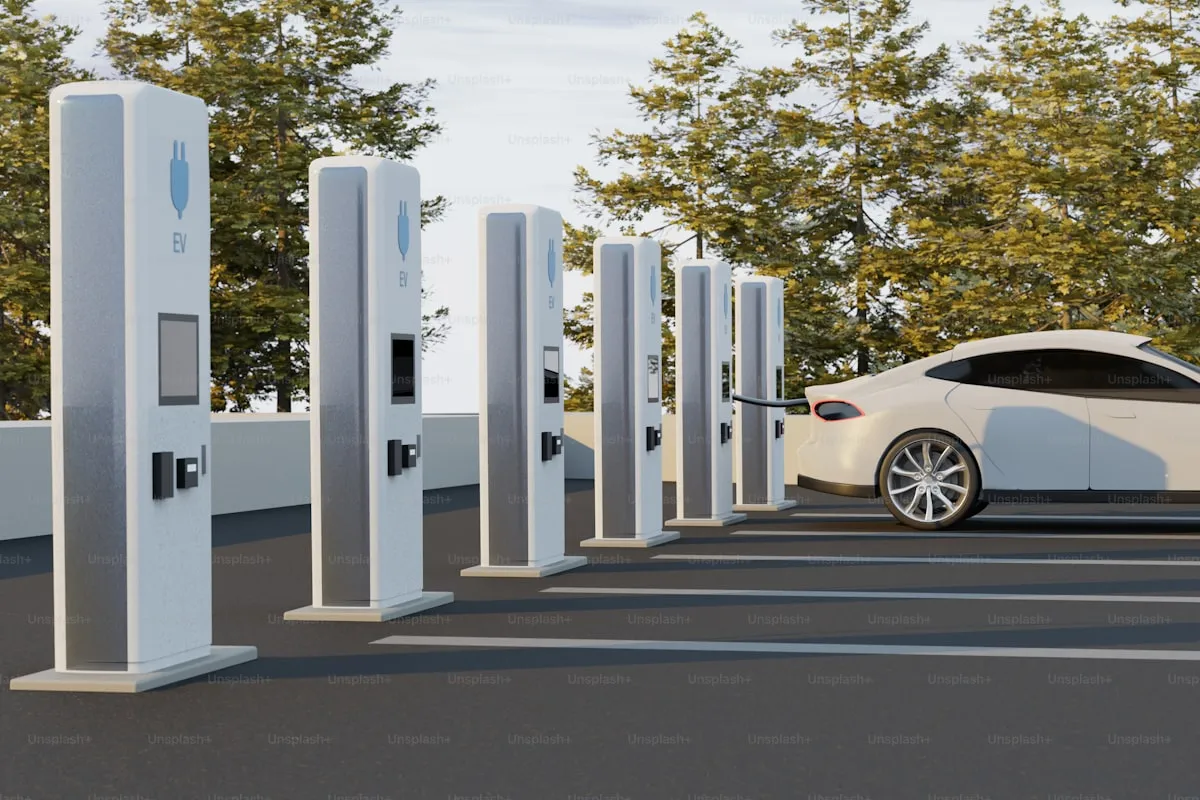
Public charging stations — Superchargers, Electrify America, ChargePoint — are often located in shopping center parking lots. This means your vehicle sits in a high-traffic parking environment for 20-60 minutes while charging. That’s 20-60 minutes of exposure to shopping carts, opening car doors, distracted pedestrians, and parking lot traffic.
Grocery store chargers are the worst. The combination of tight spaces, shopping carts, and drivers jockeying for charging spots creates a gauntlet of potential door dings and cart rash. PPF on door edges, rocker panels, and rear bumpers protects against exactly these scenarios.
North Houston’s Growing EV Population
EV adoption in the greater Houston area has accelerated dramatically. Teslas are everywhere — Model Ys in particular have become one of the most common vehicles on Highway 249 and the Grand Parkway. Rivians and Ford Lightning trucks are increasingly common. BMW, Mercedes, and Porsche EVs are filling up Woodlands-area parking lots.
This means more EV-specific protection work at shops like ours. We’ve dialed in our PPF patterns and installation techniques for the most popular EV platforms and understand the specific challenges each one presents.
Pair PPF with Ceramic Coating for Complete EV Protection
Ceramic coating over PPF provides the full protection stack: physical impact protection from the film, hydrophobic and UV protection from the ceramic layer. For EVs that spend significant time parked outdoors at charging stations or in open lots, the ceramic coating’s UV resistance helps preserve both the film and the exposed paint surfaces.
The combination also makes the vehicle dramatically easier to wash — critical for EV owners who are generally more meticulous about vehicle maintenance than average.
Frequently Asked Questions
Does PPF affect an EV’s range or aerodynamics?
No. PPF adds approximately 6-8 mils (0.006-0.008 inches) of thickness to the body panels. This has zero measurable effect on aerodynamics or range. The film weighs roughly 2-4 pounds for a full front installation — negligible on a vehicle that weighs 4,000-6,000+ pounds with a battery pack.
Can PPF be applied over Tesla’s factory PPF kit?
Tesla offers a limited factory PPF option on some models that covers small areas of the bumper and rocker panels. Professional PPF can be applied over or alongside the factory kit. In most cases, we recommend a full front kit that extends well beyond what Tesla’s factory coverage provides.
Will PPF interfere with EV sensors or cameras?
Not when installed correctly. Modern EVs have cameras, radar sensors, and ultrasonic sensors behind body panels and bumper covers. Quality PPF is optically clear and does not interfere with sensor functionality. We take care to avoid covering sensor windows directly, and the film over painted surfaces does not affect sensor operation.
Is PPF worth it on a leased EV?
Even on a 3-year lease, PPF often makes sense. Lease return inspections penalize paint damage — rock chips, scratches, and door dings can result in $500-$2,000+ in lease-end charges. PPF prevents this damage and often costs less than the penalties it avoids. Some PPF can also be transferred if you lease a new vehicle of the same type.
How does Houston’s heat affect PPF on EVs specifically?
Houston’s heat benefits PPF’s self-healing properties — minor scratches heal automatically in direct sunlight during most of the year. The heat does not cause any differential issues between PPF and EV body panels, including Tesla’s aluminum and Cybertruck’s stainless steel. Quality film from premium manufacturers is engineered for high-heat environments.
Ready to protect your EV? Get a free quote from EuroLuxe Detailing or call (713) 298-8819. We work with every major EV platform and understand the specific protection needs of electric vehicles. Serving Tomball, The Woodlands, Spring, Cypress, Magnolia, and the greater North Houston area.