PPF on white and light-colored vehicles: what owners should know
There is a persistent assumption among white, silver, and gray car owners that light paint is low-maintenance because damage is less visible than it would be on black or dark blue. In practice, the opposite is often true. Light-colored paint develops a particular kind of neglect damage — road film, oxidation hazing, and accumulated rock chips — that becomes conspicuous precisely because the surrounding paint is so uniform and bright. A chip on a white hood does not disappear. It sits there as a rust-ringed gray dot that grows in contrast over time.
Paint protection film addresses this differently than a coating or a wash schedule can. It places a physical barrier between the road and the paint surface, absorbing the energy of gravel, debris, and insects before that energy reaches the clear coat. For owners of white, silver, or pearl-finish vehicles in North Houston — where highway driving on I-249, SH-99, and SH-45 puts consistent chip pressure on front-end panels — PPF is one of the more practical protection decisions available.
This guide covers how PPF performs on light-colored vehicles specifically, what visual differences to expect, what installation looks like, and how to think about coverage decisions.
Why light paint requires a different conversation
Dark paint and light paint fail differently. On black or dark navy finishes, swirl marks and micro-scratches catch reflected light and show as silvery cobweb patterns. Owners of dark cars tend to notice paint degradation earlier and seek correction more frequently.
Light paint diffuses reflected light in a way that hides fine scratches longer — but it does not hide chips, iron fallout staining, or oxidation. White and silver finishes develop a dull, chalky appearance over time when UV exposure is consistent, which is unavoidable in the Houston climate. Silver metallic paint tends to oxidize toward a flat, washed-out look rather than the deep, liquid appearance it had when new. Pearl and tri-coat whites are particularly expensive to repair correctly when chips require color-matching, because the mid-coat mica layer must be reproduced precisely.
The financial argument for PPF on light vehicles is straightforward: repainting a front bumper on a white or silver luxury vehicle in the Houston area currently runs between $600 and $1,200 depending on the color and finish complexity. A full front PPF package that protects the bumper, hood, fenders, and mirrors absorbs most of the chip exposure those panels would otherwise accumulate over several years of highway driving.
What PPF looks like on light-colored paint
One concern owners raise consistently is whether the film will be visible on their vehicle. On light-colored paint, this concern has a specific dimension: will the film appear yellowed, hazy, or give panels a wet or glossy look that contrasts with unprotected panels?
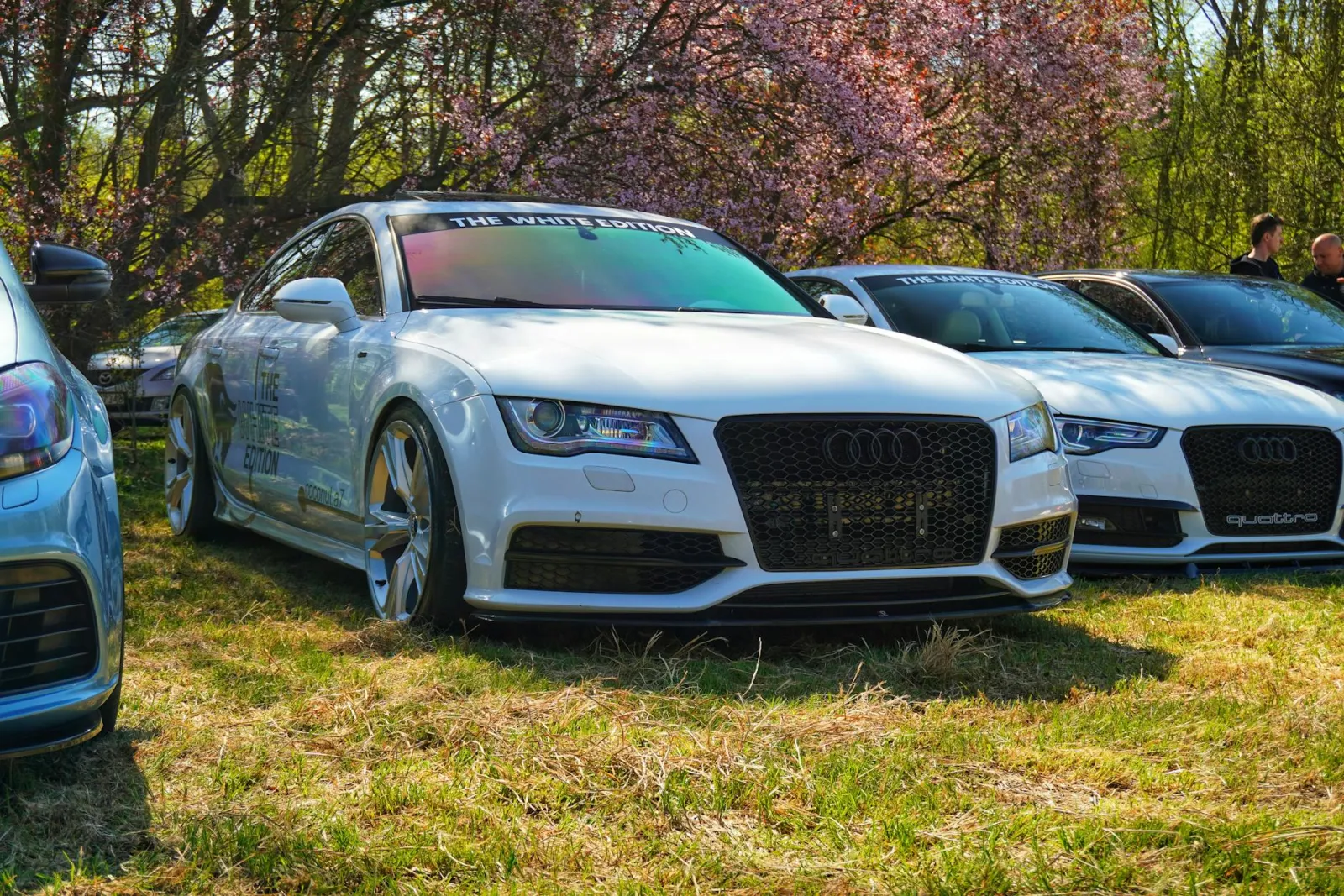
Modern TPU-based films, including the UltraFit product EuroLuxe installs, are formulated to remain optically clear over their service life under normal conditions. On white and silver finishes, the film is effectively invisible when installed correctly. The glossy version of the film will slightly deepen the perceived saturation of the paint, which most owners read as the paint looking newer rather than different. The difference in sheen between a protected hood and an unprotected roof panel is visible under certain lighting angles but is not something a person would notice in a parking lot.
Matte-finish PPF is also available for vehicles with factory matte or satin paint, which is becoming more common on white and light gray OEM finishes. That application preserves the flat appearance while providing the same physical protection.
The edges of the film, where it terminates at panel edges or curves back under the bumper lip, are the most likely place for an inexperienced eye to detect the film. Edge sealing and tucking technique during installation determine whether those termination points are clean or show a visible edge line. This is a craftsmanship variable, not a material variable.
How coverage zones translate to protection on light vehicles
Not every PPF installation covers the entire vehicle. Most owners work with a budget and a risk assessment, choosing which panels receive film based on exposure. For light-colored vehicles in this region, the priority order tends to be consistent.
The front bumper is the highest-priority panel on nearly every vehicle. It collects chips, road tar, insect impact, and parking lot contact from every mile driven. On white paint, a front bumper that goes unprotected for three years of North Houston driving will show it plainly.
The hood — particularly the leading edge and the forward third — is the second most commonly requested zone. Gravel trajectories from highway driving land heavily here, and on silver and white paint, a cluster of chips along the leading edge is one of the first things a prospective buyer notices when a car goes up for sale.
Fender edges, mirror caps, and rocker panel film follow depending on the owner’s driving profile. Drivers who spend significant time on SH-249 between Tomball and the 610 loop, or on the Sam Houston Tollway, encounter more debris per mile than drivers whose routes are primarily surface streets.
Full-body PPF on light vehicles offers the most comprehensive protection and eliminates the visible boundary between protected and unprotected paint. It is a larger investment but appropriate for new vehicles in the $60,000-and-up range where the cost of future paint correction and spot repairs over time would approach or exceed the cost of full coverage.
For owners evaluating their options, our paint protection film service page outlines the coverage packages we offer and describes what the installation process involves from drop-off to pickup.
Installation conditions and their effect on light-colored film
PPF applied to light-colored vehicles shows dust contamination under the film more readily than dark paint does. On black paint, a small piece of lint trapped under the film during installation may not be detectable in normal viewing conditions. On white or silver paint, the same contamination can appear as a visible speck.
This is not an argument against installing film on light vehicles. It is an argument for installing in a controlled environment. EuroLuxe’s installation bay is climate-controlled, which limits airborne particulate during the application process. The film is positioned and activated in a setting where temperature and humidity are managed, not in an open garage bay or outdoor setup where ambient conditions introduce variables the installer cannot control.
Before film goes down on any vehicle, the paint surface is washed, decontaminated, and inspected. Existing chips or surface contamination need to be addressed prior to installation — film applied over a chip traps moisture at the chip site and can accelerate corrosion rather than prevent it. If the vehicle has existing damage that warrants correction before PPF, we discuss that during the intake process and can incorporate paint correction into the preparation phase when needed.
Maintenance expectations after installation
PPF on a light vehicle requires straightforward maintenance. The film surface is washed the same way the rest of the car is washed — hand wash with a pH-neutral soap, using a dedicated wash mitt, without abrasive scrub pads or automatic brush equipment. Automatic car washes with spinning brushes are hard on film edges and are worth avoiding regardless of paint color.
Self-healing PPF responds to heat. Minor surface scuffs from contact — a shopping cart, a jacket zipper, a key graze — will recover when the panel heats up in the Texas sun or when warm water is poured over the area. This property applies to gloss-finish film on light paint the same way it does on dark paint. The film’s surface reverts toward its flat state as the TPU polymer relaxes.
The film itself does not need waxing, but a spray detailer compatible with PPF can be used after washing to maintain the surface and make the next wash easier. If a ceramic coating has been applied over the film, the maintenance protocol follows the coating manufacturer’s guidance, which typically means the same pH-neutral wash process.
Owners who have questions about their specific vehicle, coverage options, or how installation scheduling works at our Tomball facility can reach us at (936) 292-6056.
Making the decision for your specific vehicle
The decision to protect a white, silver, or light gray vehicle with PPF is a practical one in the North Houston context. The region’s highway infrastructure, construction-related road debris, and year-round UV exposure create conditions that accelerate the surface damage light-colored paint accumulates over time. Film does not make the vehicle look different in any way owners or observers would describe as artificial. Done correctly, it makes the paint look preserved — which, after several years, is exactly what it will be.