How PPF stops rock chips before they reach your paint
A rock chip looks like a minor nuisance until you understand what actually happened. A piece of aggregate — kicked up by the vehicle ahead of you on 249 or the Grand Parkway — leaves the road surface at roughly the same speed as traffic. It travels through the air, hits your hood or bumper at high velocity, and displaces a small column of clear coat, base coat, and sometimes primer in a fraction of a second. The result is a white or bare-metal divot that will oxidize, hold moisture, and eventually rust if left unaddressed. One chip is an annoyance. Thirty chips collected over two years of North Houston commuting is a paint condition problem.
This is the core reason paint protection film exists. Not to improve the gloss of your paint, not to simplify washing, but to absorb mechanical energy before it reaches the substrate. Everything else about PPF — the self-healing topcoat, the hydrophobic surface, the optical clarity — is secondary to that primary function. Understanding how the film performs that job helps you make a more informed decision about coverage zones, film thickness, and whether PPF belongs on your vehicle at all.
What the film is actually doing during an impact
Paint protection film is a multi-layer laminate. The bulk of its thickness is a thermoplastic polyurethane core, typically in the range of 6 to 8 mils depending on the product grade. That core is the working layer. When a stone strikes the film surface, the TPU deforms elastically — it compresses, spreads the energy laterally across a larger surface area, and recovers. The paint underneath never experiences the concentrated point load that would fracture clear coat.
UltraFit, the film we install at EuroLuxe, uses a cast TPU construction that maintains consistent thickness and optical clarity across the full sheet. Cast film does not have the internal stress that calendered film carries, which means it lies flat against complex curves and holds adhesion at edges without lifting over time. The mechanics of impact absorption depend on that consistent cross-section — a film that thins out at bends or edges has gaps in its protection profile.
The self-healing topcoat on quality PPF is a polyurethane elastomer that responds to heat. Light surface scratches — the kind left by a brush, a fingernail, or a car wash nozzle dragged across the surface — close at ambient temperature in warm climates like Houston. More significant surface marks clear with the application of warm water. This does not mean the film is indestructible. A sharp stone at highway speed can cut through any PPF. But the threshold for visible surface damage is dramatically higher than bare clear coat.
Why the leading edges matter most
Rock chips concentrate on surfaces that face oncoming debris directly: the front bumper, hood leading edge, side mirrors, headlight lenses, and the first eighteen inches or so of the front fenders. On trucks and SUVs with higher ride height, rocker panels take significant impact from tires throwing gravel outward at wheel speed. On vehicles that spend time on unpaved roads — common in the Magnolia, Tomball, and Conroe areas where new construction and ranch properties mean regular encounters with caliche and loose aggregate — rear wheel arch protection becomes equally important.
This geometry is why even a partial PPF package centered on the full front end addresses the majority of real-world chip risk. A full bumper wrap, hood, fenders, mirrors, and headlights covers the surfaces most exposed to forward-traveling debris. Owners who drive primarily on paved highways may find this coverage sufficient. Owners who spend time on gravel drives, construction zones, or rural routes typically benefit from extending coverage to rockers, door cups, and rear sections.
The decision between a partial front package and a full-body wrap is discussed in detail in our Paint Protection Film service page, which outlines the coverage tiers we offer and how we approach the consultation process.
How installation quality affects protection
Film that does not conform properly to a surface cannot absorb impact the way it was designed to. Edges that lift create channels where moisture, road grit, and contaminants enter and work against the adhesive. Overlapping seams placed in high-flex areas — like the crease of a door or the center of a hood — can peel under the thermal cycling that comes with Texas summers. A film that yellows prematurely from improper handling or low-quality UV inhibitors changes how the car looks before it fails functionally.
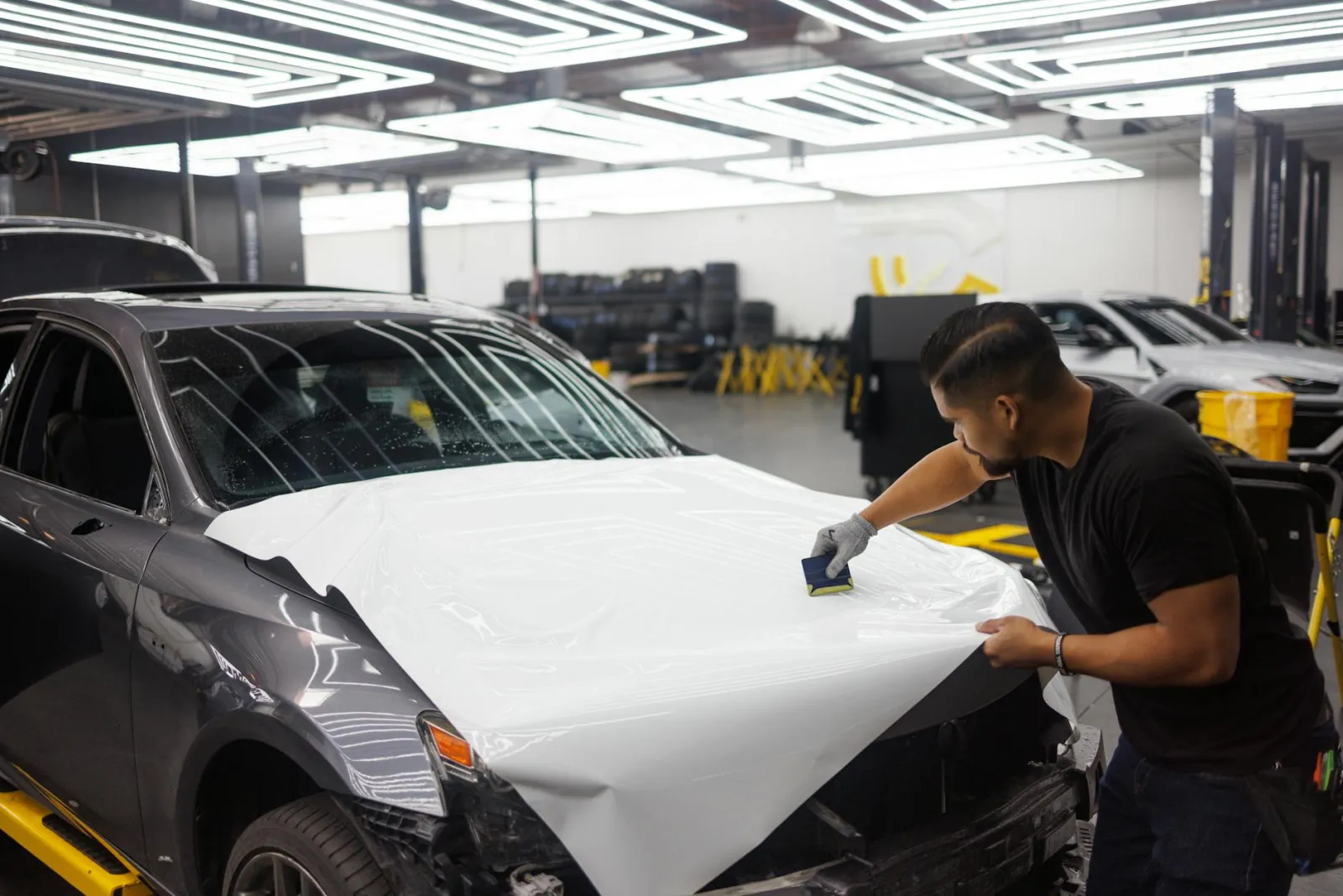
Installation environment matters more than most people expect. Dust contamination under the film causes visible debris inclusions and weakens adhesion at those points. Temperature affects how the adhesive bonds during application and how the film stretches to conform. Our installation bay at EuroLuxe is climate-controlled specifically because these variables are controllable indoors and completely uncontrollable in a parking lot or open bay environment. The film itself is only part of the equation.
Plot lines in the film — faint marks left by inattentive bulk-cutting before application — are a visible sign that a shop is not taking prep seriously. Proper installation involves precision pattern cutting, careful squeegee work, and edge tucking on every panel. On complex surfaces like hood contours and bumper fascias with deep recesses, a heat gun is used to help the film conform without introducing stress. This is skilled trade work, and the results are visible under direct light when it is done correctly and equally visible when it is not.
The relationship between PPF and paint condition
Paint protection film does not fix paint. It encapsulates whatever condition the paint is in at the moment of installation. If a car arrives with swirl marks, oxidation, or fine scratches, those defects will be preserved under the film and magnified by the gloss of the film surface. This is one of the most consequential misunderstandings in the PPF category.
On a used vehicle with moderate swirling, paint correction before film application is not optional — it is the only way the finished result will look correct. On a new car that has been through dealership prep, transport, and lot exposure, a light single-stage correction or at minimum a decontamination wash is standard before any film goes down. The goal is to protect the best possible version of the paint, not to seal in a problem that will be visible every time light hits the hood at the right angle.
This is why our intake process at EuroLuxe includes a paint inspection before every PPF job. We assess condition under controlled lighting, discuss what correction is warranted, and give the owner an honest assessment rather than a minimum-scope quote designed to win a price comparison.
What PPF does not protect against
Setting expectations accurately matters. Paint protection film stops rock chips, resists bird droppings and road tar long enough for them to be removed safely, and absorbs minor abrasive contact. It does not prevent deep keying, does not protect the roof from hail at impact energies typical of a significant Texas storm, and does not stop a door ding from a parking lot neighbor. Self-healing properties address topcoat surface marring — they do not reverse impacts that have distorted the TPU layer itself.
Over time, any PPF will require maintenance and eventually replacement. A quality film installed correctly on a vehicle that is washed properly should maintain its optical clarity and adhesion for seven to ten years in most North Houston use cases. Vehicles that park in direct sun daily, are washed frequently with harsh chemistry, or sustain heavy debris exposure will see shorter film life. When the film does reach end of service, proper removal by a trained installer is important — adhesive residue and paint sensitivity are real concerns if removal technique is poor.
For owners who want to extend film longevity further, a ceramic coating applied over the PPF creates a surface that is easier to clean, more resistant to chemical staining, and retains that new-installation gloss longer. We cover that layered approach and when it makes sense in more detail separately.
Making the right decision for your situation
The case for PPF is strongest on vehicles that see regular highway mileage, commute routes with heavy truck traffic, or roads near active construction — all of which are constant features of North Houston driving. The case is also strong on new vehicles where the owner intends to keep the car long-term or wants to preserve resale condition without the cost of spot repaints. The case is weaker on high-mileage daily drivers with existing paint damage where the economics of protection no longer favor the investment.
If you have questions about coverage options or want an accurate quote for your specific vehicle, you can reach us at (936) 292-6056 or stop by 11701 Holderrieth Rd in Tomball. An honest conversation about what your car actually needs is the most useful thing we can offer before any money changes hands.
Rock chips are a solved problem for vehicles that have quality PPF installed correctly by someone who knows what they are doing. The film absorbs the impact, the paint stays intact, and the vehicle holds its value and appearance over time. That is the entire proposition, and it holds up in practice.