How Long Does Ceramic Coating Actually Last on a Daily Driver?
Ceramic coating products advertise lifespans of 3 years, 5 years, even 10 years. If you drive the car every day in Houston — parking outdoors, hitting automatic washes, dealing with heat and UV and construction dust — those numbers need serious context.
Here’s an honest assessment of what drives real-world coating lifespan, what shortens it, and how to tell when yours has degraded enough to need attention.
Manufacturer Claims vs. Reality
Product manufacturers test coatings in controlled conditions. They apply the coating correctly, cure it fully, maintain it with pH-neutral products, store the vehicle properly, and measure performance at intervals. Under those conditions, a professional-grade coating like GYEON MOHS EVO legitimately lasts 5+ years.
The daily driver experience looks different. You’re parking in direct Texas sun. You’re commuting through construction zones. You’re using whatever car wash is convenient. And the coating is performing — degrading slowly — through all of it.
A realistic lifespan for a daily driver depends more on behavior than product. With proper maintenance, 3–5 years on a GYEON MOHS EVO application is achievable. With poor habits, the same coating can be functionally depleted in 18 months.
What Degrades a Coating Faster
Automatic Car Washes
This is the biggest one. Tunnel car washes use high-pH alkaline detergents and abrasive brushes or harsh high-pressure systems. Alkaline cleaners chemically attack the silica structure of a ceramic coating. A single tunnel wash doesn’t destroy a coating — but regular weekly tunnel washes over six months will strip hydrophobic performance significantly.
The brushes compound the problem. Even “brushless” tunnel washes use soft cloth strips that collect grit and drag it across the paint. The coating absorbs that abrasion. Over time, the surface loses its water beading behavior and starts to look like uncoated paint.
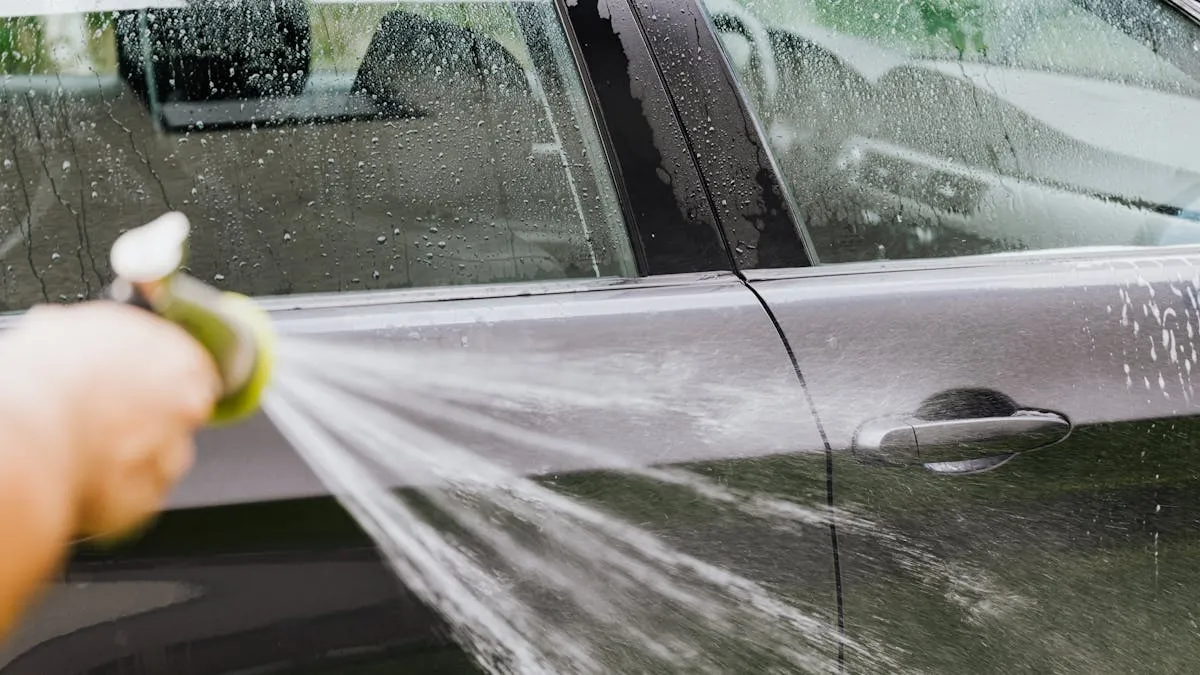
If you want the coating to last, hand washing or touchless washes with pH-neutral soap are the correct approach.
Parking Outdoors in Direct Sun
UV exposure degrades every paint protection product over time, including ceramic coatings. Houston’s UV index is among the highest in the continental US for most of the year. A vehicle parked outside 365 days per year in Tomball or Cypress ages its coating faster than one garaged nightly.
This doesn’t mean parking outdoors is a dealbreaker — it means the coating will need reapplication sooner, and a maintenance coating (a topper applied annually) makes more of a difference for outdoor-parked vehicles.
Harsh or Incorrect Cleaning Products
Any cleaner with a pH above 9 or below 5 will attack a ceramic coating. This includes many common degreasers, wheel cleaners, and “all-purpose” spray cleaners. The coating is pH-sensitive — that’s by design, because the silica cross-linking that creates hardness and hydrophobicity is chemically vulnerable at extremes.
Stick to pH-neutral car wash soap and coating-safe detailing sprays for regular maintenance.
Skipping Annual Maintenance
A ceramic coating isn’t install-and-forget. Annual decontamination — iron remover, clay bar treatment, and inspection — removes embedded contaminants that accumulate on the surface and reduce performance. A maintenance coating topper applied annually essentially renews the hydrophobic layer without needing a full reapplication.
Owners who skip maintenance for three or four years and then wonder why the coating isn’t beading water anymore have usually watched it degrade incrementally without addressing it.
What Maintenance Actually Extends Life
Wash correctly. pH-neutral soap, two-bucket method or foam cannon, and a microfiber wash mitt. Rinse thoroughly before contact. No brushes.
Apply a maintenance spray after washes. Products designed as coating boosters — applied to a wet or dry surface after washing — replenish hydrophobic performance and provide additional chemical resistance. This takes five minutes and makes a measurable difference over time.
Annual decontamination and inspection. Iron contamination bonds to the coating surface and can’t be removed by washing alone. An annual iron decontamination treatment removes these deposits and lets you assess how the coating is performing.
Keep the vehicle garaged when possible. Even partial coverage during the hottest hours reduces UV load significantly.
How to Know When Reapplication Is Needed
The most reliable test is water behavior. On a properly functioning ceramic coating, water beads into tight, high-contact-angle beads and sheets off panels efficiently during a rinse. When beading becomes flat or absent — water sheets into wide, low contact angle sheets or doesn’t bead at all — the hydrophobic layer is depleted.
A second indicator is gloss. Ceramic coatings add depth and reflectivity to paint. When a coated vehicle starts to look similar to an uncoated car under raking light, the coating has thinned.
Neither of these means the paint is unprotected — some chemical resistance and UV protection remain even in a degraded coating — but they indicate the coating is no longer performing at specification.
If you’re noticing flat water behavior or reduced gloss on your current coating, bring the vehicle in. Sometimes the right move is a maintenance treatment and topper. Sometimes the coating has degraded past that point and a reapplication makes more sense. Either way, it starts with looking at the actual paint.
For most daily drivers in North Houston, a ceramic coating with proper maintenance realistically delivers 3–4 years before reapplication. That’s a better value than waxing every 3 months, and it does more for the paint in the process.
Call EuroLuxe at 936-292-6056 with questions or to schedule an assessment. We’re in Tomball and work with clients from across the North Houston area.
Keep Your Vehicle Looking Its Best
Ceramic Coating: How Long Does It Last?
How to Wash a Ceramic Coated Car
Pro vs Consumer Ceramic Coating: What’s the Difference?