How to protect your car's paint when you park outside
Most vehicle owners in North Houston do not have a climate-controlled garage. A covered parking pad, a driveway that bakes in the afternoon sun, or a neighborhood where shade trees drop sap and pollen for six months of the year — that is the reality for a large portion of drivers in Tomball, Spring, Magnolia, and Conroe. The assumption that good paint care is only possible with covered storage is worth questioning. Outdoor parking does accelerate paint wear, but how much depends almost entirely on the choices you make when the car is not moving.
The threats are layered. UV radiation breaks down clear coat over time, turning it chalky and dull. Houston’s summer heat accelerates that process because oxidation rates increase with temperature. Add iron fallout from brake dust, tree sap, bird droppings, and pollen left sitting on paint for days between washes, and you have a surface that degrades faster than most owners expect. The good news is that every one of those threats has a practical countermeasure, and most of them do not require a garage.
The priority is not perfection. It is slowing the rate of degradation to a pace where the paint still looks presentable at five years and correctable at ten. That goal is achievable for outdoor-parked cars if you are consistent about a handful of habits.
Wash frequency matters more than wash method
The most common mistake outdoor-parked car owners make is washing too infrequently. Contaminants do most of their damage while they sit. Bird droppings are acidic and can etch into clear coat within hours in direct sun. Pollen and tree sap become increasingly bonded to the surface the longer they cook. A car parked outside in spring or summer should be washed at a minimum every seven to ten days, and more often during pollen season or after storms.
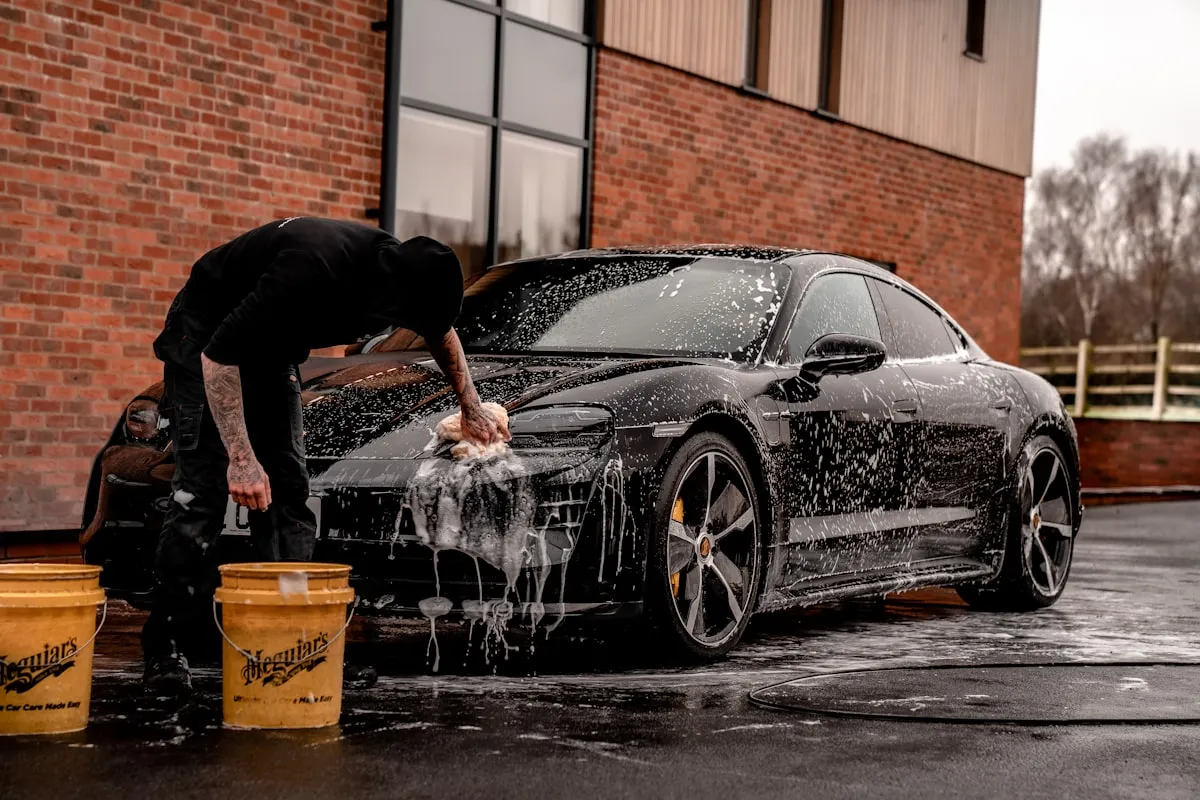
The method still matters. A proper two-bucket hand wash or a touchless automatic wash is significantly less damaging than a brush-style tunnel wash. If hand washing, rinse thoroughly before making contact with any mitt or sponge, and use a clean microfiber wash mitt with a quality automotive shampoo. Skipping the pre-rinse or using the same side of a dirty mitt across multiple panels is how most wash-induced swirl marks happen.
After washing, dry the car with a clean waffle-weave or twisted-loop microfiber towel. Letting a car air-dry in direct sun leaves water spots, particularly in areas with hard water like much of the North Houston suburbs. Those spots are mineral deposits, and when they etch into clear coat they require machine polishing to remove.
Protective coatings change the equation for outdoor vehicles
A bare clear coat on an outdoor-parked car is working without a net. Some form of protective layer — whether a consumer-grade spray sealant, a professional paint sealant, or a ceramic coating — slows UV penetration, makes the surface easier to wash, and reduces how aggressively contaminants bond.
For vehicles that live outside permanently, ceramic coating is the most durable option by a significant margin. A properly applied professional ceramic coating creates a chemically bonded layer over the clear coat that resists UV degradation, makes water and contaminants sheet off rather than sit, and maintains a level of protection that wax and consumer sealants cannot match over time. The hydrophobic effect also means that bird droppings and pollen have less surface contact and are easier to rinse off between washes, which reduces the window in which they can cause damage.
The important caveat is that ceramic coating applied over compromised paint does not fix what is already there — it locks it in. If the paint has existing swirl marks, light scratches, or early oxidation, those need to be addressed through paint correction before a coating goes on. Applying a coating over defects in hopes of hiding them does not work, and it wastes the investment.
Position and shade: use what is available
Not all outdoor parking spots are equal. Even without a permanent covered structure, there are choices that reduce paint exposure. Parking on the north side of a building, under a carport, or under a mature deciduous tree in winter (when it has no leaves and therefore drops no sap) can meaningfully reduce UV exposure. That said, trees are a double-edged situation in spring and summer — sap and pollen from overhead foliage cause more chemical damage than sun alone during those months.
If you have the option, choose a parking position that minimizes afternoon sun exposure. In North Houston, the sun tracks west-southwest in summer afternoons, and that is where the highest UV and heat load lands on a parked car. A car angled so its hood faces north or east in the afternoon takes noticeably less direct heat than one facing west.
A quality car cover is an option worth considering for vehicles that are not driven daily. A breathable, properly fitted cover blocks UV and keeps contaminants off the surface between uses. The risk with car covers is that dust and grit trapped under the cover during removal can scratch the paint. Covers need to be clean before they go on, and they should not be dragged across the surface.
Decontamination is not the same as washing
Regular washing removes surface dirt and loose contaminants. It does not remove iron fallout, bonded mineral deposits, or tar. These require dedicated decontamination steps — an iron remover spray and a clay bar or clay mitt — and they should be part of your maintenance routine at least twice a year for outdoor-parked vehicles, and potentially quarterly in high-fallout environments like neighborhoods near busy roads or industrial areas.
Iron contamination is particularly worth understanding. Brake dust from your own vehicle and from surrounding traffic embeds into paint as tiny metallic particles that rust and expand over time. You cannot see them easily, but you can feel them — run a clean finger across a recently washed panel and if it feels rough or gritty, you have embedded contamination. Left long enough, those particles cause staining and paint damage that cannot be washed away.
Decontamination before any protective coating application is not optional — it is part of the process that determines whether the coating bonds correctly and lasts as long as it should. If you are preparing for a service or just doing seasonal maintenance at home, iron remover followed by clay treatment gives you a surface that is chemically and mechanically clean, not just visually clean.
Managing expectations: what outdoor parking actually costs your paint
An honest assessment: a vehicle parked outdoors in a Houston suburb will show more paint wear over ten years than the same vehicle kept in a climate-controlled garage. That is not a reason to give up on paint care — it is a reason to be more systematic about it. The gap between a well-maintained outdoor-parked car and a garage-kept car that never gets washed or protected is wider than the gap between outdoor and indoor parking alone.
Owners who wash consistently, treat the surface with a durable protective coating, decontaminate twice a year, and address paint defects before they compound will have vehicles that hold up well and retain significantly more resale value than those who do not. Paint is one of the first things a buyer or appraiser sees, and the cost of neglect is priced in accordingly.
If you want an honest evaluation of where your paint stands and what protection makes sense for your situation, the team at EuroLuxe is reachable at (936) 292-6056. The studio at 11701 Holderrieth Rd in Tomball works with daily drivers and outdoor-parked vehicles regularly — the approach is the same as with any other car: assess what is there, correct what needs correcting, and apply protection that is appropriate for how the vehicle actually lives.
Outdoor parking is not a death sentence for paint. It is a set of conditions that call for a consistent, informed response — and most of that response is straightforward once you understand what you are protecting against.