PPF for A-pillars and roof rails: the areas most owners skip
Most conversations about paint protection film start at the front of the car and work backward — hood, fenders, bumper, mirrors. That is a reasonable place to begin because the nose of the vehicle takes the heaviest debris load at highway speed. But there is a category of panels that sits above all of that, exposed to the same road grit, the same ultraviolet radiation, and the same weather cycles, yet rarely appears on a standard PPF quote: the A-pillars and roof rails. For owners who spend real money on a front-end package and then leave those surfaces unprotected, the inconsistency tends to show up a few years down the road in ways that are difficult and expensive to fix.
This is not a niche concern. A-pillars — the painted structural members that frame the windshield on each side — are among the first places automotive paint shows UV-induced fading and chalking because they face the sky at an angle that maximizes solar exposure. Roof rails, whether they are integrated flush body-color rails on a crossover or the raised rails on a truck or SUV, collect road spray thrown up by the windshield edges, tree sap, pollen, and pine pitch in areas like The Woodlands and Magnolia where tall pines line residential streets. The combination of UV and organic contamination accelerates clear coat degradation faster than most owners expect.
Understanding why these zones are overlooked requires a quick look at how PPF packages are typically structured, and why the standard tiers do not always reflect where protection is actually needed.
Why standard PPF packages leave upper body zones exposed
The PPF industry built its package tiers around statistically high-impact zones: the front bumper absorbs road debris at the lowest point, the hood and fenders take direct chip strikes from aggregate kicked up by the vehicle ahead, and the mirrors intercept side-angle debris. Those priorities are legitimate. A partial front package stops the most common damage on most vehicles for most drivers.
The problem is that standard package tiers were designed around sedans and sports cars, where A-pillars are relatively short and roof rails either do not exist or are minimal. As the market shifted heavily toward SUVs, crossovers, and trucks — which dominate North Houston driveways — the upper body surface area grew substantially. A three-row SUV has A-pillars that are taller, wider in cross-section, and more exposed than those on a compact sedan. Its roof rails may run the full length of the vehicle, adding several square feet of body-color painted or anodized metal that sits in direct sun all day.
Most shops simply do not include those surfaces in pre-built package pricing because the coverage has to be cut and fitted individually. It requires additional film and additional installation time. For installers who are moving volume, it is easier to quote a standard zone list. At a studio doing careful, climate-controlled work on one vehicle at a time, there is no reason to leave those surfaces off the conversation.
What actually happens to unprotected A-pillars over time
Painted A-pillars on modern vehicles are typically finished in body color, which means they carry the same clear coat as every other painted panel. That clear coat degrades under UV exposure through a process called photooxidation — the same mechanism that turns unprotected paint chalky, dull, and eventually crazed. Because A-pillars face directly upward and often catch reflected UV off the windshield glass, they can show early degradation even when the hood and doors still look acceptable.
Beyond UV, A-pillars catch a specific type of mechanical abrasion that other panels do not. Every time you drive through rain or a car wash, water flows along the windshield surface and funnels toward the A-pillar edge, carrying grit with it. That channeled water erosion is slow but cumulative. Over four or five years on a daily driver in North Houston, the clear coat at the windshield edge of an unprotected A-pillar can show measurable thinning and early micro-scratching that paint correction alone cannot fully address without compromising remaining clear coat thickness.
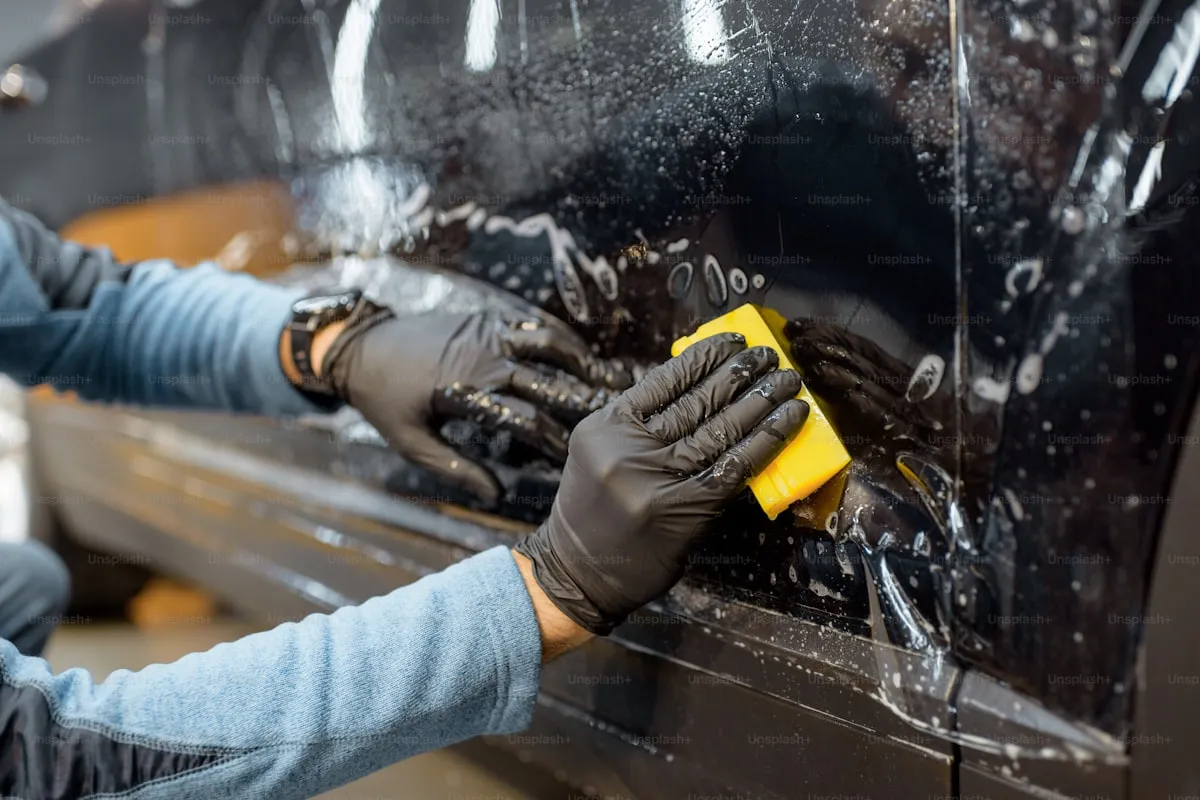
Film applied to the A-pillar intercepts both the UV load and the channeled abrasion. Because UltraFit film includes a self-healing topcoat layer, light abrasion marks from wash water or contact disappear with ambient heat — which, in a Texas summer, means the film is effectively healing itself on a daily basis.
Roof rails: the surface that gets ignored until it is too late
Roof rails present a different but equally serious problem. On body-color painted rails — common on luxury crossovers and SUVs — the paint sits on a horizontal surface that collects standing water after rain. In areas with moderately hard water, like much of the North Houston metro, that standing water leaves mineral deposits every time it evaporates. Do that a few dozen times through a wet season and the rail surface develops a layer of bonded mineral scale that requires aggressive decontamination to remove, sometimes with some polish work to address the etching underneath.
On vehicles where the rails are a brushed aluminum or anodized finish rather than painted, PPF serves a different function: it prevents the rail surface from picking up the kind of surface oxidation and scratching that comes from luggage straps, cargo brackets, or just the repeated UV exposure that dulls anodized metal over time. Film on an aluminum rail keeps the surface looking as-delivered indefinitely.
For owners who use their roof rails functionally — mounting a roof rack, attaching crossbars, loading kayaks or cargo boxes — the case for film is even stronger. Every attachment point is a potential abrasion zone. Film absorbs that contact damage and remains replaceable; the rail surface underneath does not change.
How to approach adding upper body coverage to a PPF plan
If you are planning a paint protection film installation from scratch on a new vehicle, the right time to discuss A-pillars and roof rails is before the quote is finalized. Adding those surfaces during the original installation is always more efficient than returning for a second appointment, because the installer already has the vehicle staged, the film pre-cut patterns loaded, and the panel edges accessible. Retrofitting film to A-pillars after the rest of the car is done is entirely possible, but it adds coordination time and a second drop-off.
If you have an existing PPF package that did not include upper body zones, an inspection will determine whether the current A-pillar and rail surfaces need any preparation before film goes on. Paint that has already developed early UV hazing or mild water spot etching benefits from a light paint correction pass to remove the existing damage before the film locks the surface in place. Applying film over a compromised surface does not restore what is underneath — it just stops further damage from accumulating.
For vehicles under two or three years old that have been mostly garage-kept, the upper surfaces are usually clean enough to film directly. For daily drivers with several years of unprotected exposure, an honest assessment of the current paint condition should happen before anyone schedules the film appointment.
Getting an accurate assessment for your vehicle
No two vehicles present the same upper body coverage requirements. A full-size truck with painted body-color bedsides and extended cab pillars needs different planning than a compact crossover with short A-pillars and minimal roof structure. The paint finish — whether it is single-stage, clear-coated solid, metallic, or pearl — also affects which prep steps are necessary and how film adhesion should be approached.
The most useful first step is a direct conversation with an installer who will look at your specific vehicle rather than sell you a pre-built package without examining what is actually there. You can reach EuroLuxe Detailing at (936) 292-6056 to schedule that kind of evaluation before committing to any coverage plan.
Protecting the obvious panels on a vehicle is straightforward. Protecting the surfaces that silently degrade until the damage becomes irreversible takes a more deliberate approach — and A-pillars and roof rails are exactly the kind of investment that makes sense to address before the problem becomes visible rather than after.