
How to protect your car's paint between professional details
Most vehicle owners treat a professional detail as the finish line. The car leaves the shop looking exactly right, and the assumption is that it will hold that way for months without much effort. That assumption is wrong, and it costs people real money. Paint degradation is cumulative. Every unattended bird dropping, every improper wash, every afternoon spent in direct Texas sun without protection is removing a fraction of the investment you made at the shop. What you do between professional visits determines how much work the next visit requires.
This is not about replicating what a professional installer does. You are not going to machine-polish your paint in the driveway, and you should not try. The goal is simpler: avoid the mistakes that accelerate damage and develop a maintenance rhythm that keeps contamination and surface defects from compounding between appointments.
The habits described here apply whether your vehicle has a ceramic coating, a layer of paint protection film, both, or neither. The specifics change slightly depending on what protection is already on the car, but the core principles are the same.
Wash frequency and why it matters more than method
In the North Houston area — Tomball, The Woodlands, Cypress, Conroe, Katy, Spring — vehicles accumulate contamination fast. Industrial fallout from petrochemical corridors, heavy tree pollen in spring, road grime from construction zones along the Grand Parkway and 249, and the sheer volume of bugs from highway driving mean your paint is under constant attack. Letting that contamination sit is the primary cause of paint degradation between details.
The right wash frequency for most daily drivers in this region is every one to two weeks. That schedule is more important than any product you buy. A car washed regularly with a basic two-bucket hand wash will always be in better shape than one washed aggressively once a month.
Avoid drive-through tunnel washes with spinning brushes or foam pads. Those contact surfaces carry abrasive contamination from previous vehicles and deposit swirl marks in your clear coat with every pass. Touchless washes are less harmful mechanically but rely on harsh chemical concentrations to compensate for the lack of physical agitation, and repeated use degrades any coating on the paint faster than necessary.
How to wash without introducing new scratches
A proper hand wash does not require a lot of equipment, but it does require the right sequence. Start with a rinse-down from top to bottom using a standard garden hose or a pressure washer kept at a safe distance — around 18 to 24 inches from the surface at low to medium pressure. This pre-rinse loosens surface contamination so you are not dragging it across the paint with your mitt.
Use two buckets: one with fresh shampoo solution and one with clean water for rinsing your mitt between panel passes. Dip the mitt, wipe one panel in straight lines rather than circles, rinse the mitt in the plain water bucket, and reload with suds before moving to the next section. Circles are how swirl marks are created. Straight lines parallel to the direction of airflow over the panel are the correct technique.
For drying, a clean microfiber waffle-weave towel or a forced-air blower is the right tool. Squeegees concentrate pressure on small contact points and drag any remaining particles. Chamois leathers, whether real or synthetic, are too stiff for modern clear coats and should not be on your car at all.
Handling contaminants between washes
Bird droppings and tree sap are the two most damaging contaminants you will encounter regularly in North Houston, particularly if you park under live oaks or near utility lines. Both are acidic and both begin etching clear coat within hours of contact in the Texas heat. A dropping that might take two days to cause visible damage in Minnesota can etch measurably in a matter of hours on a 95-degree afternoon here.
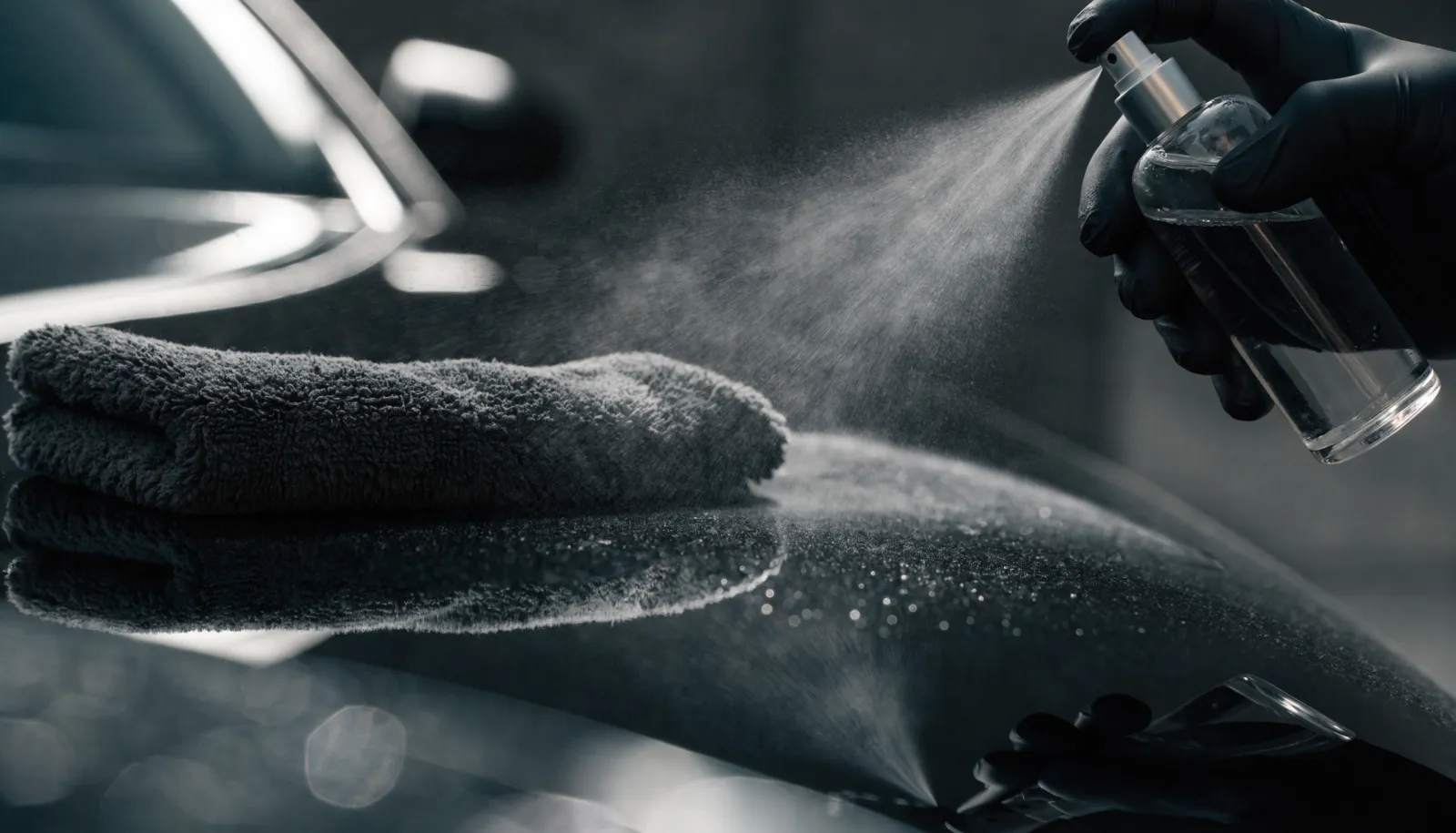
Keep a spray detailer or quick detailer bottle in your vehicle. When you find a fresh dropping or sap spot, soak it with the spray, let it dwell for thirty seconds to soften the material, then lift it with a clean folded microfiber without rubbing. Do not try to wipe it dry. The goal is to float the contamination off the surface, not scrub it across the paint. If the spot has dried and hardened, a dedicated decontamination product with isopropyl alcohol or a dedicated sap remover is appropriate before resorting to any physical pressure.
Iron fallout — the fine metallic particles shed by brake dust and rail dust that embed in your paint — is not something you will see between washes, but you will accumulate it. Running your clean hand across a washed panel that feels rough or gritty despite being clean is the sign. An iron decontamination spray every two to three months dissolves those particles chemically without any abrasive contact.
Protecting the surface after washing
If your vehicle has a professional ceramic coating, the coating itself provides the primary layer of chemical resistance and hydrophobicity. What you can do to extend its performance is apply a ceramic spray booster after every three to five washes. These spray-and-rinse or spray-and-buff products are not a substitute for the base coating, but they reinforce the hydrophobic layer that washes diminish over time. Gyeon products make several options that are compatible with a professional Gyeon coating base, and using the same product family matters because not all spray boosters are formulated to bond correctly with professional-grade coating chemistry.
If your vehicle does not have a coating, a quality paint sealant applied every four to six months is the minimum maintenance step that makes any meaningful difference. Carnauba wax looks good for two to four weeks and then is essentially gone. It was never designed for a Texas summer. A synthetic sealant gives you actual polymer bonding to the clear coat and lasts long enough to be worth the effort of application.
Parking choices and their effect on paint
No wash schedule compensates for parking decisions that accelerate damage. Covered parking, even a carport, reduces UV exposure by a significant margin compared to full-sun outdoor parking. UV radiation is the single largest driver of clear coat oxidation and color fade over a vehicle’s life. If covered parking is not available, a high-quality fitted car cover is a reasonable investment for vehicles that sit outdoors for extended periods.
Park away from the edge of parking lots when possible. Door dings from adjacent vehicles account for a substantial share of the minor paint damage that shows up in detail shops. A two-spot buffer from other cars is not always feasible, but it is worth the extra walking when the vehicle warrants the care.
Avoid parking under large trees unless you plan to check the car and address contamination quickly. Live oaks and pine trees deposit sap, pollen, and biological debris continuously. The shade benefit rarely outweighs the contamination risk, particularly during the spring pollen peak that hits The Woodlands, Magnolia, and Conroe hard every March through May.
What to leave to the professionals
Between-visit maintenance covers cleaning, decontamination, and surface protection. It does not cover correction. If you notice swirl marks, light scratches, water spot etching, or oxidation beginning to appear, those require machine polishing with the appropriate compound or polish to address correctly. Attempting to fix them with over-the-counter scratch fillers or excessive hand polishing typically makes the visual outcome worse, not better, and complicates the correction work at the next professional visit.
Establishing a regular schedule — professional service once or twice a year paired with consistent home maintenance between visits — is far more cost-effective than neglecting the paint for eighteen months and then needing extensive correction work before any protective coating can be applied.
If you have questions about what your specific vehicle needs or want to talk through a maintenance schedule that fits how you use your car, reach out to the team at EuroLuxe at (936) 292-6056. We are located at 11701 Holderrieth Rd in Tomball and work with owners throughout North Houston who want to stay ahead of paint degradation rather than catch up to it.
The gap between professional visits is where most paint damage actually happens. A simple routine — consistent wash schedule, fast response to bird droppings and sap, appropriate surface protection, and smart parking choices — closes that gap substantially and keeps your paint looking close to how it left the shop until the next appointment.