How to protect your car's paint during a Houston summer
North Houston summers are not gentle on vehicle finishes. From late May through September, UV index readings routinely push into the extreme range before noon, ambient temperatures on exposed asphalt can exceed 160 degrees Fahrenheit, and afternoon thunderstorms bring acidic rain, pollen loads, and the occasional hail cell. Each of those factors attacks clear coat in a different way, and most owners underestimate how much cumulative damage builds up over a single season.
The good news is that most of the damage is preventable. It does not require daily effort or exotic products, but it does require understanding what is actually happening to the paint so you can address the right problems in the right order.
What heat and UV are actually doing to your clear coat
Automotive clear coat is a urethane-based film typically between 40 and 80 microns thick. Prolonged UV exposure breaks down the photoinitiators in that film, causing it to chalk, oxidize, and eventually lose its ability to hold gloss. This process accelerates significantly above 120 degrees Fahrenheit, which is exactly where an unshaded hood sits on a July afternoon in Tomball or Conroe.
The UV damage itself is not reversible once the clear coat has oxidized past a certain depth. What looks like dullness on a white or silver car is often the first visible stage of clear coat failure. On darker colors the same process shows up as a milky or faded appearance in the highest-exposure areas, typically the roof, hood, and trunk lid. Paint correction can remove early-stage oxidation by cutting through to undamaged clear coat, but the window to save the original finish is finite.
Heat also accelerates the bonding of environmental contaminants. Tree sap, bird droppings, and insect acids all etch into clear coat faster when the panel surface is hot. A drop of bird acid that might take a week to cause etching at 70 degrees can leave a permanent mark in a matter of hours on a panel sitting at 140 degrees.
The role of washing frequency in a Texas summer
During pollen season and peak summer, washing more often than you might instinctively think is the right call. Every day a car sits in the open, it collects pollen, dust, industrial fallout from highway traffic, and organic contamination from trees. When afternoon rain hits that layer of accumulated grime, it does not rinse it off cleanly. It mixes with the contamination and pushes it into the surface, then the water evaporates and leaves concentrated minerals and organic acids behind as water spots.
A weekly hand wash using a pH-neutral soap is a reasonable minimum for a daily driver in North Houston from May through September. The wash method matters as much as the frequency. A proper two-bucket method with a clean microfiber mitt generates far less swirl damage than a single-bucket approach, and it matters even more in summer because softened clear coat scratches more easily when it is hot. Wash in the early morning or in shade whenever possible, and never wash a panel that is hot to the touch. Thermal shock and accelerated water spotting are both real risks when soap and rinse water hit a 140-degree surface.
Pre-rinsing the car thoroughly before any mitt contact is also non-negotiable in summer. Dry dust and grit sitting on the surface acts like sandpaper the moment a mitt touches it. A foam cannon pre-wash or even a thorough hose-down before contact washing removes the majority of loose abrasives before your mitt ever makes contact.
Parking choices compound the damage faster than most owners realize
No product on the market fully compensates for parking a car in direct Texas sun for eight hours a day, five days a week. Covered parking, whether a garage, carport, or shaded structure, is the single most effective thing an owner can do to slow UV degradation and reduce the cycle of heat-bake-contaminate-spot that defines a Houston summer.
For owners without access to covered parking at work, a car cover is a reasonable second option, though covers need to be clean before use and require the paint to be clean underneath them. A dirty cover on a dirty car generates its own set of abrasion problems.
Park-and-walk is worth considering in large parking lots. Vehicles parked at the edge of a lot near tree cover often accumulate more sap and bird contamination than those parked in open rows. A spot under heavy tree canopy trades UV protection for organic contamination risk. Neither is ideal. For most daily drivers, a covered structure wins on every metric.
What a protective coating actually does in summer conditions
A properly installed professional ceramic coating creates a sacrificial layer of silica-based material above the clear coat. That layer is significantly harder than clear coat, is chemically inert to most organic acids at reasonable exposure times, and provides measurable UV resistance. It does not make paint bulletproof, but it changes the terms of the fight substantially.
On a ceramic-coated surface, bird droppings and tree sap are much easier to remove before they bond and etch because the surface chemistry resists adhesion. Water beads and sheets off rather than sitting in contact with the panel, which reduces water spotting from afternoon rain. And the coating itself absorbs a portion of the UV load that would otherwise be working on the clear coat beneath it.
The caveat is that a ceramic coating performs at its designed level only if the paint underneath it was properly corrected and decontaminated before application. Coating over oxidized or swirl-marked paint seals those defects in place under a hard shell. This is why the inspection and preparation stage is the majority of the work in any professional coating installation.
Paint protection film takes a different approach and addresses a risk that ceramic coating does not cover well: physical impact. Rock chips, highway road debris, and parking lot door dings are a daily reality on 249, I-45, and the Grand Parkway. A thermoplastic urethane film absorbs those impacts and, in the case of self-healing film, can recover minor surface scratches with heat exposure. For the panels that take the most debris load, typically the hood, full front bumper, fenders, and mirror faces, film provides a level of protection that no coating chemistry can match.
Managing the aftermath of summer storms
Houston’s summer thunderstorms leave behind more than water. The rain picks up atmospheric pollution, pollen, and particulates on the way down and deposits them on your paint in a diluted but still acidic solution. Once that solution evaporates, the mineral and acid residue remains bonded to the surface, often visible as white water spots.
The correct response after a significant rain event is to wash the car within 24 to 48 hours rather than waiting for the next scheduled wash. If you cannot wash immediately, a quick rinse to dilute and remove the surface contamination is better than nothing. Water spots that are allowed to sit through another full day of 95-degree heat and UV exposure become substantially harder to remove.
For owners dealing with existing water spot damage, a paint decontamination service can address mineral deposits that washing alone will not remove. Severe water spot etching that has bitten into the clear coat requires paint correction to cut back to undamaged material. The sooner that work is done, the less depth needs to be removed and the more clear coat remains for the life of the vehicle.
Putting together a practical summer routine
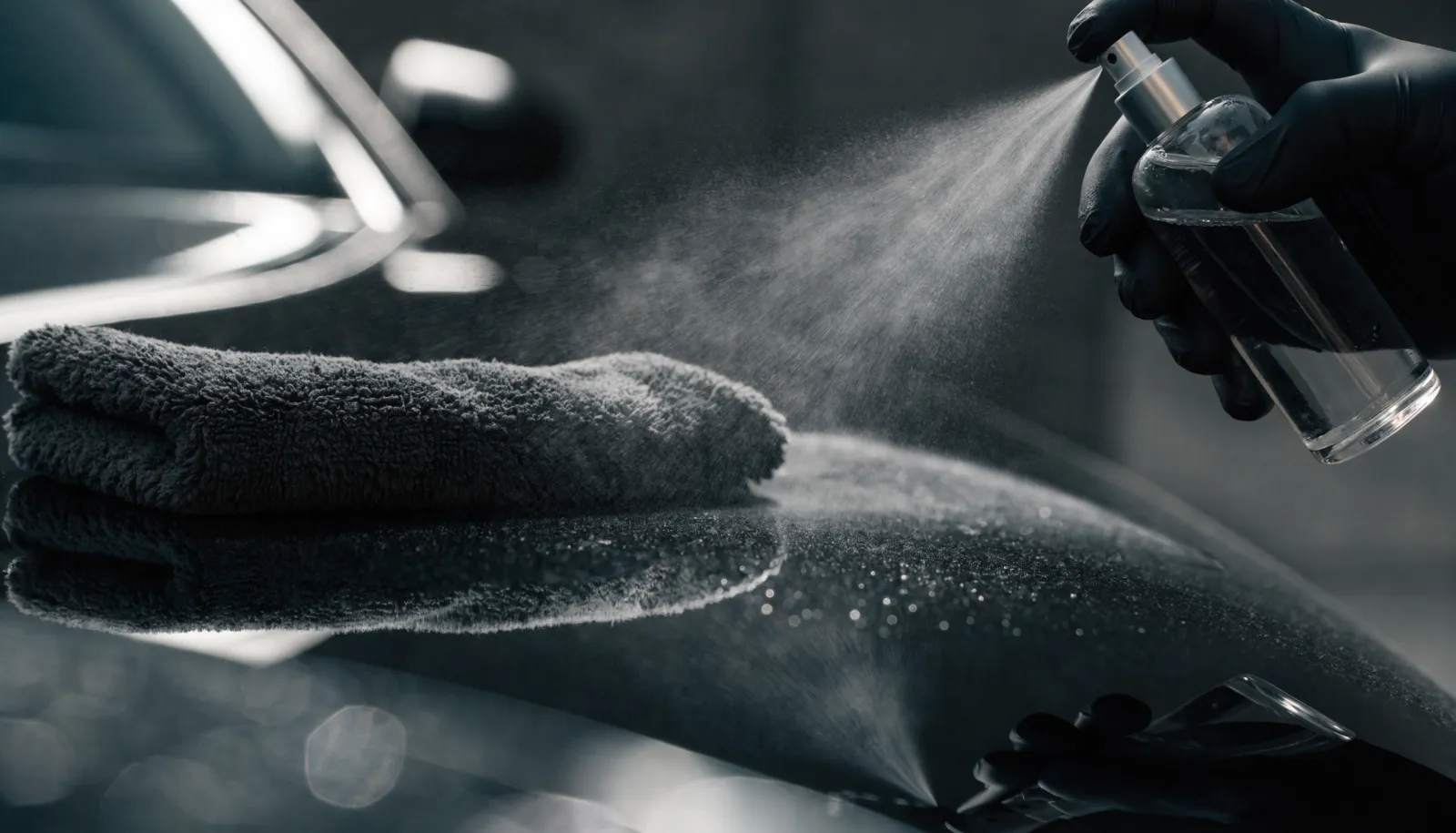
A sustainable summer care routine for most North Houston owners looks like this: hand wash weekly using a two-bucket method and pH-neutral soap, rinse after any significant rain event within a day or two, apply a spray detail product or ceramic boost spray after each wash if the car is coated, keep the vehicle out of direct sun whenever covered parking is available, and address bird droppings or sap within hours rather than days during the peak heat months.
That routine is not complicated, but it requires consistency. Most of the paint damage that ends up requiring professional correction is not the result of a single catastrophic event. It accumulates wash by wash, parking spot by parking spot, over the course of a summer and then repeats across several years until the clear coat no longer has the depth to correct back.
If you have questions about where your paint currently stands or what protection level makes sense for how you use the vehicle, the team at EuroLuxe is reachable at (936) 292-6056 and the shop is located at 11701 Holderrieth Rd in Tomball. An inspection takes less than twenty minutes and gives you a clear picture of what the paint needs before you invest in any product or service.
The Houston summer is predictable in its intensity, which means the damage it causes is largely preventable if the right habits and protections are in place before June arrives. Most owners who show up in August with oxidized, water-spotted, or rock-chipped paint wish they had started that conversation in April.