PPF for rocker panels: protecting the most battered body section
Most owners think about paint protection film in terms of the hood, the fenders, and the front bumper. Those are the obvious targets, and they deserve coverage. But there is a strip of bodywork that absorbs more accumulated punishment than any of those panels, and it rarely gets mentioned until the paint is already gone: the rocker panel, the horizontal section that runs beneath the doors between the wheel arches. On most vehicles it sits four to six inches off the ground, which puts it squarely in the trajectory of everything the front tires throw rearward at highway speed.
In North Houston, the problem is compounded by road conditions that include fresh chip-seal resurfacing on county farm roads, gravel shoulders on routes like FM 2920 and FM 1774, and construction debris that migrates onto SH-249 from the ongoing toll corridor expansion. Drivers commuting through Tomball, Magnolia, and Spring are running a daily gauntlet at those lower body zones whether they realize it or not. By the time the damage becomes obvious — bare metal, rust bloom, or primer showing through — the repair cost has climbed well past what prevention would have cost.
This post covers why rocker panels are the single highest-impact-per-square-foot area on a vehicle, what a proper paint protection film application looks like in that zone, and how the work is done when it is done correctly.
Why rockers take more damage than any front panel
The physics are simple. Tires accelerate debris upward and rearward as they rotate. At 60 mph, a pebble ejected from the tread contact patch hits the rocker panel with roughly the same energy as a thrown stone. Because the tire is spinning so fast, the strike pattern is continuous, not occasional. Add trailing vehicles running on the same lane, and the rocker gets hit from both the front wheel’s ejection and whatever the rear wheel picks up coming out of road texture changes and expansion joints.
Front panels get rock chips concentrated at specific impact points. Rockers get a steady, wide-area sandblasting. Over time this produces a pattern of micro-chips that erodes the clear coat, then the color coat, then reaches primer. Once primer is exposed, the panel oxidizes quickly, especially in Houston’s humid climate where moisture sits in every micro-crack.
Factory paint on rockers is often thinner than on horizontal surfaces because spray application angles are less favorable during assembly. Some manufacturers apply a rubberized coating to the lower rocker, but that material scuffs, tears, and traps moisture underneath once it is compromised. It is not a long-term barrier.
What PPF does differently in this zone
Urethane paint protection film is flexible, impact-absorbing, and bonded directly to the paint surface. When a rock strikes it, the film deforms and rebounds rather than transferring impact energy straight to the clear coat. The damage is contained within the film itself, and in the case of self-healing formulations, minor surface scuffs fill back in with gentle heat.
For rockers specifically, film thickness matters more than in other zones. A thicker mil rating gives the film a larger elastic deformation range before the impact stress reaches the adhesive layer and the paint beneath. UltraFit film, which is what EuroLuxe Detailing installs, is engineered with an optically clear TPU top layer that resists yellowing and carries that self-healing behavior. On a panel like the rocker that sees constant low-level abuse rather than occasional high-energy strikes, the durability of the urethane chemistry is what makes the installation last.
The film also creates a sealed barrier against moisture. A well-installed rocker panel PPF application, properly wrapped at the edges and sealed, keeps road grime and water from working into any existing micro-texture in the paint and prevents the oxidation cycle from starting.
How a proper rocker installation is actually executed
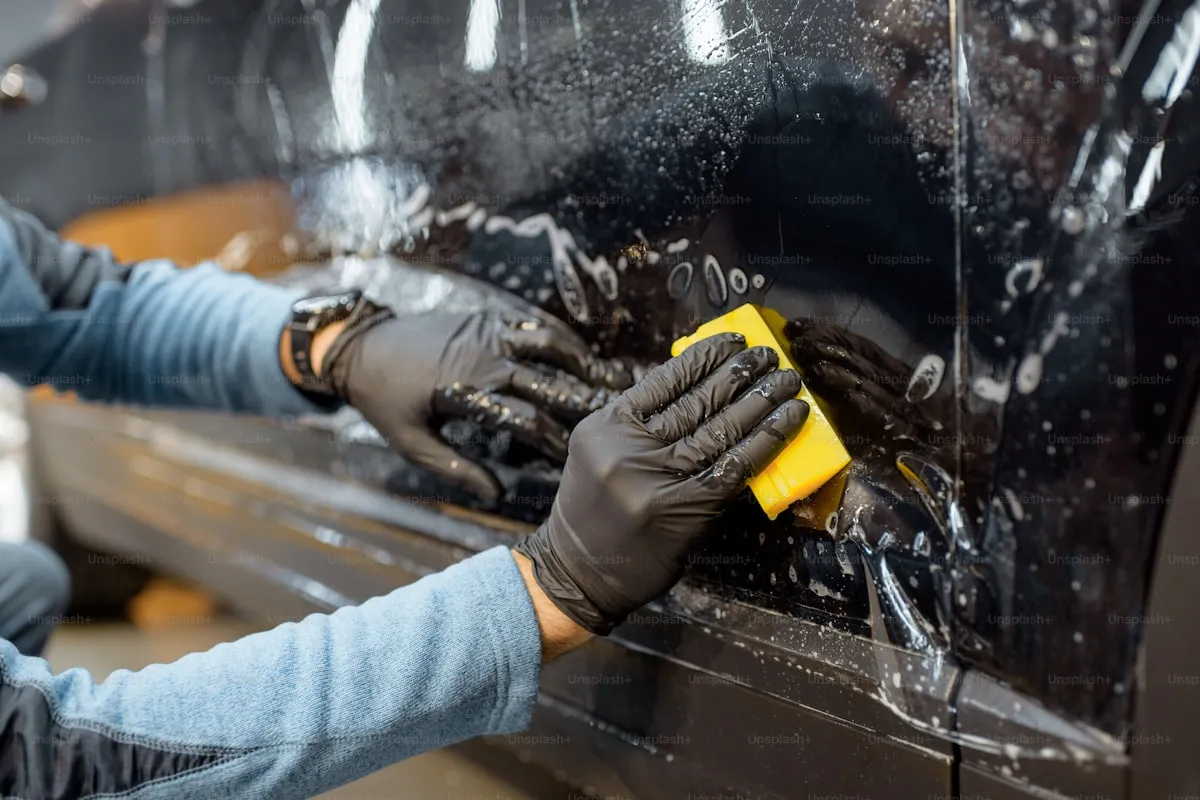
The preparation work for a rocker panel install is straightforward but non-negotiable. The panel surface is decontaminated, clay-barred if iron or fallout is present, and fully dried before the film is placed. Any existing chips or paint defects below the film will be visible after installation, so if the rocker already has a cluster of rock chips, paint correction or spot repair work happens first. Film over damaged paint does not fix what is under it — it just preserves the current state indefinitely.
The film is cut using a computer-plotted template matched to the vehicle’s year, make, and model. Templates account for body feature lines, drainage channels, and the geometry of how the rocker meets the front and rear bumper fascias. Attempting to hand-cut rocker film on the vehicle without a template is one of the more common signs of an inexperienced installer — you end up with straight edges over curved transitions, and those edges lift faster than wrapped edges because they have no mechanical lock.
In a climate-controlled installation bay like the one at EuroLuxe, the film is handled at a stable temperature. Urethane film is temperature-sensitive during application: too cold and it becomes rigid and tears at stretch points, too warm and it over-stretches, thinning the film at curves. The bay environment eliminates that variable, which is particularly relevant in Texas where ambient temperatures outside range from near-freezing on January mornings to triple digits in August.
Coverage decisions: rocker only, or combining with adjacent panels
The rocker does not exist in isolation on the vehicle body. The lower section of each door, particularly the few inches above the rocker seam, gets the same debris load. The area behind the front wheel arch — sometimes called the quarter rocker or rear rocker extension — catches ejection from the rear tire. If you are protecting the rocker, it is worth considering whether to extend coverage to those adjacent zones at the same time.
This is a practical rather than upselling point. Film on a rocker panel with an unprotected lower door panel means the film boundary sits right where debris hits. That boundary line will show evidence of impact over time on the unprotected side. Extending the film a few inches up the door creates a continuous barrier through the highest-impact band.
Full lower-body packages typically include the rockers, lower door sections, the lower front bumper leading edge, and often the rear wheel arch lip. For vehicles that see daily highway use — which describes most North Houston commuters running 249 or 99 through construction zones — a full lower-body package provides coverage where the actual risk is concentrated rather than protecting only the cosmetically prominent front panels.
What to expect after installation
New film has a slight haze during an initial cure period, typically 24 to 48 hours, while the adhesive finishes setting and residual moisture from installation activates out. After that window, the film is effectively invisible on most paint colors. On very dark or gloss-black paint, a slight sheen difference can sometimes be detected at low angles, but it is not noticeable under normal lighting conditions.
Maintenance is simple. The film washes the same way the rest of the vehicle does, with a pH-neutral car soap and a soft wash medium. Avoid directed steam and pressure washer nozzles held close to film edges. The self-healing surface handles minor swirl marks from wash contact and light scuffs from brush contact in tight parking areas. If the film is cut, torn, or significantly damaged by a particularly aggressive impact, the damaged section can be replaced without affecting the surrounding original paint — which is the entire point of the protection.
Film on a rocker panel will typically outlast film on a front bumper in terms of visual integrity because the strike profile is smaller and more diffuse, rather than concentrated high-energy single impacts from highway debris. A quality rocker install, done properly and maintained correctly, should hold up for seven to ten years before any cosmetic consideration of replacement comes up.
If you want to evaluate your vehicle’s current rocker condition or discuss a lower-body protection package, the team at EuroLuxe Detailing can be reached at (936) 292-6056. The shop is at 11701 Holderrieth Rd in Tomball, and the conversation starts with understanding what the vehicle is being used for and where the actual risk exposure is before anything else.
The rocker panel is the most consistently abused surface on a vehicle and one of the least glamorous to think about protecting, but the math on prevention versus body shop repair is not complicated. Film there is not a luxury add-on — it is the most practical application of paint protection film on the entire car.